The Easterlin Paradox

Amar Pandit , CFA , CFP 

November 10, 2026 | 12 Minute Read
There is a question about money that becomes more interesting the more money you have.
When does more stop feeling like more?
The question is not when money stops being useful. Money remains extraordinarily useful. It buys food, shelter, healthcare, education, comfort, experiences, freedom, privacy, choices and time. It can protect us from many of life’s financial shocks. It can help our children. It can allow us to care for our parents. It can give us the ability to walk away from situations we no longer wish to tolerate.
Money matters… Many a times enormously.
However, there is another question hiding underneath the first one.
If money keeps increasing, does happiness keep increasing with it?
If Rs. 1 Crore makes us happier than Rs. 10 Lakh will Rs. 10 Crore make us ten times happier than Rs. 1 Crore? If Rs. 10 Crore improves our life enormously, will Rs. 100 Crore improve it by the same proportion? If Rs. 100 Crore becomes Rs. 500 Crore, what exactly has changed in the experience of an ordinary Tuesday afternoon?
These questions sit at the heart of one of the most fascinating ideas in economics. It is called the Easterlin Paradox.
In 1974, economist Richard Easterlin published work that would eventually help create an entire field around the economics of happiness. He noticed something strange. At a given point in time, richer people tended to report greater happiness than poorer people. Richer countries also tended to be happier than poorer countries.
So far, there is nothing particularly surprising. Everyone would probably know this.
However, when Easterlin looked at what happened over time, the relationship became much more puzzling. As countries became substantially richer, average happiness did not necessarily rise alongside income in the way one might have expected.
Income had grown. Living standards had improved. People owned more, consumed more, traveled more and lived in larger homes. They had access to technologies and conveniences that previous generations could barely have imagined. Yet happiness had not marched upward at anything resembling the same rate.
This contradiction became known as the Easterlin Paradox.
The research around this question has evolved considerably since then. Economists continue to debate exactly how income and happiness interact. Some studies find that well-being continues rising with income rather than reaching one universal ceiling. Others find that the relationship changes depending on whether we measure daily emotional well-being, overall life satisfaction, income levels or the social circumstances surrounding that income. We do not need to settle every academic argument to see the profound truth hiding underneath the debate.
Money can dramatically improve a life without improving happiness indefinitely in the same proportion.
Understanding this key point matters enormously for investors. This is because the entire machinery of investing is built around a very simple idea.
“More.”
We save because we want more. We invest because we want our savings to become more. We take risk because we hope to earn more. We compare funds to see which generated more. We compare portfolios. We compare returns. We compare net worth.
We set targets… Rs. 1 Crore… Rs. 5 Crore… Rs. 10 Crore… Rs. 25 Crore… Rs. 100 Crore… Rs. 500 Crore… and the goal post keeps moving. Somewhere along this journey, without consciously deciding to do so, we begin treating the accumulation of money as if it were the objective of life rather than one of the tools available to build a life.
This is where the Easterlin Paradox becomes much more than an interesting economic observation. It becomes deeply personal.
Imagine someone named Rajiv. At 30, Rajiv earns Rs. 15 Lakh a year.
He has a young family, a home loan and very little financial cushion. A large, unexpected expense can genuinely disturb his life. He thinks carefully before taking a holiday. He worries about his children’s education. Losing his job would create immediate anxiety.
For Rajiv, more money can change a lot.
If his income doubles, he may move from financial fragility towards financial stability. He can build an emergency fund. He can buy better health insurance. He can invest for his children’s education. He can take his family on a holiday without worrying about the credit-card bill for months afterwards.
Money has not merely increased his bank balance. It has removed pain. This is an enormously important function of money.
Now imagine Rajiv at 45.
His career has gone well. His income is significantly higher. The home loan is manageable. His children’s education is funded. He has accumulated several Crores across investments. There is adequate insurance, liquidity and a growing retirement corpus.
More money still matters. It creates choices. He can retire earlier…travel more… help his parents… upgrade his home… give his children opportunities he never had.
Money is still improving his life.
Now imagine Rajiv at 60.
He has Rs. 50 Crore. His house is paid for. His children are financially independent. His retirement is more than adequately funded. Even under conservative assumptions, his financial resources are likely to exceed what he and his wife will consume during their lifetimes.
Then his portfolio becomes Rs. 60 Crore.
Has his life improved?
Maybe.
How much has his life improved by?
Now imagine it becomes Rs. 65 Crore… Then Rs. 70 Crore… Then Rs. 75 Crore.
At some point, another Rs. 5 Crore may dramatically change the spreadsheet without meaningfully changing breakfast tomorrow morning.
The house is the same. The people around the table are the same. The morning walk is the same. The conversation with his wife is the same. His health is the same. His relationship with his children is the same.
The number has changed enormously. The life may barely have changed at all. This is where the idea of diminishing returns becomes deeply human.
The first few increments of wealth can transform life because they solve real problems. Money can move us from hunger to food, insecurity to shelter, dependence to independence, anxiety to resilience and limitation to choice. However, once those problems have largely been solved, every additional rupee must work much harder to produce the same improvement in life.
The first Rs. 1 Crore and the fiftieth Rs. 1 Crore do not perform the same emotional job.
One may create security. The other may simply change a number. Even then, something fascinating happens. Our desire for the next Crore does not necessarily diminish at the same rate as its usefulness.
This is one of money’s greatest paradoxes.
The marginal utility of money can decline while the desire for more continues growing.
Why?
This is because the reference point moves… The goal post has moved… When you have Rs. 1 Crore, Rs. 5 Crore looks rich. When you have Rs. 5 Crore, you begin meeting people with Rs. 20 Crore. When you have Rs. 20 Crore, somebody in your social circle has Rs. 100 Crore. At Rs. 100 Crore, you discover somebody with Rs. 500 Crore. At Rs. 500 Crore, you are invited into rooms where people discuss billions.
There is always another room and there is always somebody richer inside it. This is one of the great traps of relative wealth.
Human beings do not experience money only absolutely. We experience it comparatively. We look sideways.
The question quietly changes from: “Do I have enough?” to: “Do I have as much as him?”
Those questions lead to completely different lives. The first has the possibility of an answer. The second does not.
This does not end even when you become a billionaire because there will almost always be someone with more. In fact, there is a real story of a US billionaire, who in his New York skyscraper is not even in the top 10 richest people in his building. He has publicly admitted feeling not so rich.
There is always someone with a larger house… a more expensive car… a bigger portfolio… a more successful business… a better-performing investment… a second home somewhere which you don’t…a holiday you have not taken… a number on a rich list you have not reached.
Comparison can make an objectively wealthy person feel poor without taking a single rupee away from him.
Think about how extraordinary that is.
Nothing in your financial life has deteriorated. Your house has not become smaller. Your portfolio has not declined. Your income has not fallen. Your family has not lost anything. In fact, by every objective measure, your life may be exactly as good as it was yesterday.
Then somebody you know becomes much wealthier and suddenly, what was enough yesterday begins to feel inadequate today. Your circumstances did not change. Your reference point did.
This is one of the strangest things about money. As I have written above, we do not experience wealth only in absolute terms. We experience it relative to expectations, to our past and, perhaps most dangerously, to the people around us. A person with Rs. 10 Crore can feel extraordinarily wealthy in one room and strangely inadequate in another, even though not a single rupee has disappeared from his bank account.
This is one of the reasons more money cannot keep producing more happiness at the same rate forever. As our circumstances improve, our expectations quietly rise with them. What once represented abundance slowly becomes normal. What once felt like a privilege eventually begins to feel like a necessity… Luxury once used becomes a necessity.
The first business-class flight can feel extraordinary. After enough of them, business class is no longer extraordinary, while economy somehow begins to feel unbearable. The first beautiful car can feel like a symbol of achievement. A few years later, it is simply the car parked downstairs. The first Rs. 10 Crore may feel almost unimaginable when you are starting out. Eventually, Rs. 10 Crore can become merely the reference point from which Rs. 25 Crore is evaluated.
Psychologists describe part of this phenomenon as hedonic adaptation. Human beings possess a remarkable ability to adjust to changes in circumstances. This is one of our great psychological gifts when life becomes difficult because we often recover emotionally from adversity better than we imagine we will.
However, the same mechanism has another side. We also get used to the good.
The raise, the promotion, the new house, the beautiful car, the holiday, the portfolio milestone, the liquidity event, the inheritance and the success of the business can each create a genuine burst of happiness. For a while, life feels different. Something we wanted for years has finally arrived.
Then something fascinating happens.
Life absorbs it.
The extraordinary slowly becomes ordinary. The new house becomes home. The dream car becomes transportation. The portfolio milestone becomes a number on a statement. The income that once represented success becomes the income required to maintain the life that success created and once the extraordinary becomes ordinary, the mind begins searching for the next extraordinary thing.
This is why the finish line around money has such a mysterious habit of moving. We imagine that happiness is waiting at a particular number. When we finally reach that number though, we often do not find a finish line waiting for us.
We find another number.
Ask somebody at 35 how much money would make him feel financially secure and he might say Rs. 5 Crore. When he reaches Rs. 5 Crore, the answer becomes Rs. 10 Crore. At Rs. 10 Crore, Rs. 20 Crore feels safer. At Rs. 20 Crore, he begins thinking about inflation, longevity, children’s inheritance, medical costs and whether Rs. 30 Crore would really be more prudent.
The arithmetic can always be made to justify another number. Sometimes those concerns are entirely legitimate but sometimes something else is happening.
We are not moving towards enough. We are moving enough away from ourselves.
This is a real problem. This is where financial planning, at its best, should become philosophical.
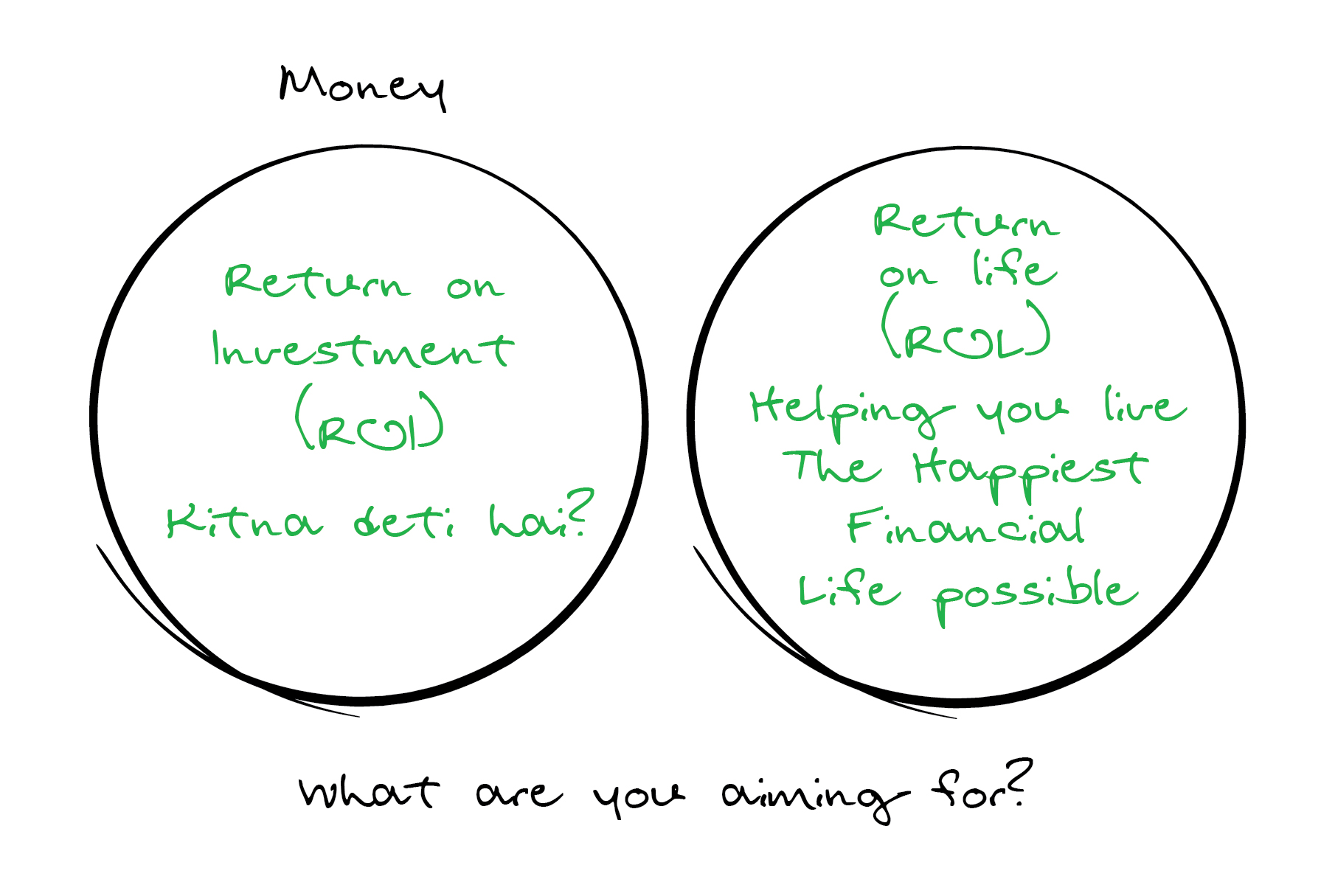
The industry spends enormous amounts of time answering questions such as: How much return can you earn? Which fund should you buy?
How much equity should you own? What is the optimal asset allocation? How much will Rs. 10 Crore become at 12 per cent?
These are useful questions but eventually there is a much more important one. Regular readers of this blog would know this by now.
What is the money for?
It sounds almost embarrassingly simple, but I have found that many people spend their entire financial lives accumulating money without ever answering it properly.
We are extraordinarily clear about the means and surprisingly vague about the end. We know the portfolio return to two decimal places. We know the asset allocation. We know how much our neighbor sold his business for.
On the other hand, ask someone: “What would a deeply meaningful and fulfilling life actually look like to you?”
Suddenly the conversation becomes much harder because no Bloomberg terminal can answer that. No mutual fund factsheet can answer it. No Excel model can answer it. No amount of compounding can compensate for never having asked it.
This is why I sometimes think the most dangerous thing about wealth is not losing it. It is spending your entire life accumulating it without discovering what it was supposed to enable. Imagine spending forty years climbing a ladder only to realize that you never asked which wall you wanted it leaning against. The tragedy would not be that you failed to climb high enough. The tragedy would be that you climbed magnificently in the wrong direction…
To Be Continued…
Wishing you and your loved ones a Very Happy, Healthy, and Amazing Diwali 🤗♥️



 and then tap on

0 Comments