Ahead of What?

Amar Pandit , CFA , CFP 

September 8, 2026 | 5 Minute Read
A few weeks ago, I was having coffee with a friend when, somewhere in the middle of our conversation, he said something that sounded perfectly normal.
“I just want to get ahead.”
I nodded.
After all, it is a phrase we hear all the time. Parents want their children to get ahead. Entrepreneurs want their businesses to get ahead. Investors want their portfolios to outperform the market. Somewhere along the way, “getting ahead” has quietly become one of the most accepted ambitions of modern life.
But as our conversation continued, I found myself asking him a question that neither of us had expected.
“Ahead of what?”
He looked at me for a moment and said, “I don’t know…I guess…ahead.”
“Ahead of what?” is a question we almost never ask, perhaps because we assume we already know the answer. Yet the more I have reflected on it, the more I have realized that much of modern life is built around an ambition that very few people ever stop to examine.
We all want to get ahead. The phrase sounds so natural that we rarely pause to ask the obvious question.
Ahead of whom?
And perhaps even more importantly…
To what end?
One of the strangest things about getting ahead is that nobody ever tells us where the finish line is.
The target quietly keeps moving.
The young professional believes life will feel different once she earns twenty lakh rupees a year. Then someone else begins earning thirty. The entrepreneur dreams of building a hundred-crore business until he meets someone who has built one worth a thousand crore. The investor who once hoped to accumulate five crores now finds himself wondering whether ten would feel safer. Then twenty begins to sound more sensible. Somewhere along the journey, enough quietly disappears from the vocabulary.
This is not because our lives have become worse; it is because comparison has quietly rewritten the definition of success.
Money is perhaps the greatest amplifier of this phenomenon.
Very few people wake up one morning and decide they need another ten crore because their lives genuinely require it. More often, they discover someone else has reached that milestone first. A neighbor buys a larger home. A colleague upgrades to a more expensive car. A friend retires earlier than expected. Someone posts photographs from a holiday that appears just a little more extraordinary than your own.
Without realizing it, another competitor quietly joins the race. No one invited us to this race. We invite ourselves.
The more I observe our profession, the more I wonder whether we unintentionally encourage this endless race. We celebrate outperformance, compare portfolios, rank funds and publish lists of the wealthiest individuals as though success can always be understood only in relation to someone else’s results. We classify individuals as HNIs, UHNIs and billionaires, as though placing a label on wealth somehow tells us something meaningful about the quality of a person’s life.
These comparisons are undoubtedly useful when they remain tools for analysis. They become dangerous when they quietly become tools for identity. Because the moment we begin measuring ourselves by where we stand relative to everyone else, money ceases to be a means of creating a meaningful life and slowly becomes a way of keeping score in a race that never truly ends.
Many years ago, I met an entrepreneur whose business had grown far beyond anything he had imagined in his twenties. By almost every conventional measure, he had won. His company was thriving. His wealth had multiplied. His success was obvious to everyone around him.
Yet during one of our conversations, he asked me something I have never forgotten.
“Amar, at what point do you know you’ve arrived?”
It wasn’t a financial question; it was an existential one.
The more I reflected on it, the more I realized that he had stumbled upon one of the great paradoxes of modern life. We spend years trying to get ahead, yet very few of us ever pause to define what “ahead” actually means. The destination remains frustratingly vague, and because it is never clearly defined, the finish line has a habit of moving every time we think we are getting close. You don’t stop running. You simply become faster at it.
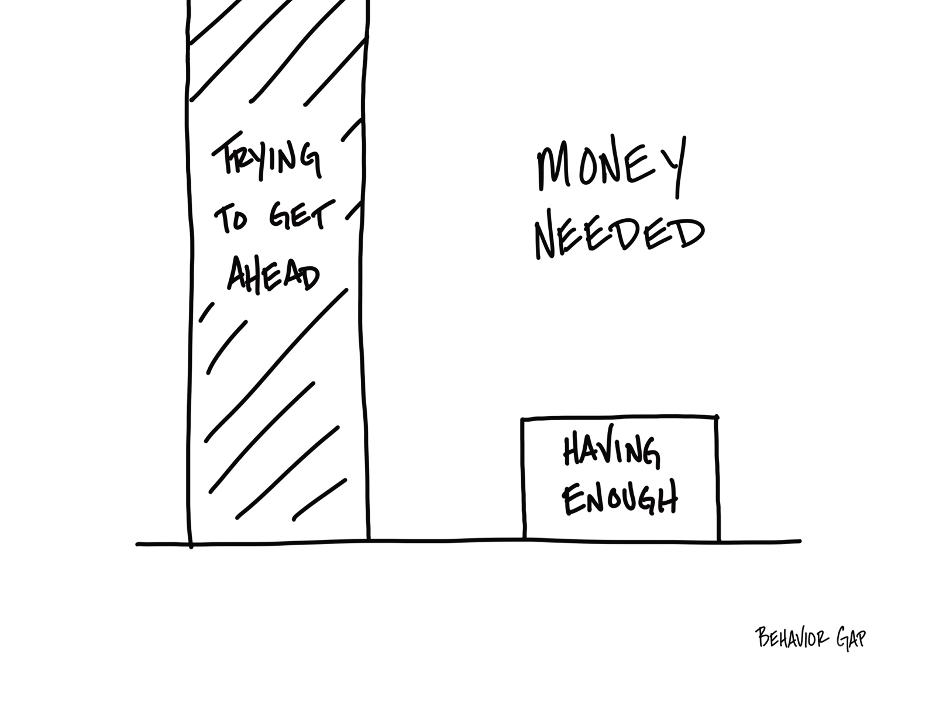
That is perhaps why I find this sketch so fascinating. The amount of money required to live a deeply fulfilling life is often far smaller than the endless effort required to stay ahead of everyone else. One journey eventually reaches a place called “enough.” The other has no natural destination because comparison is an infinite game. Every milestone simply reveals another person who has travelled a little further.
Please don’t misunderstand me. There is absolutely nothing wrong with ambition. I admire ambitious people because they are often the ones who create the world we all benefit from. Entrepreneurs build businesses that create jobs. Scientists devote their lives to expanding the boundaries of human knowledge. Artists leave behind works that continue inspiring generations long after they are gone. Progress has always depended on people who wanted to build something better.
The question, therefore, is not whether ambition is good; the question is what our ambition is serving.
There is a profound difference between striving to become the best version of yourself and spending your life trying to become better than somebody else. One journey is driven by purpose. The other is driven by comparison. From a distance they may look remarkably similar, but they lead to very different destinations.
The first journey has no losers. The second almost always does.
The more experienced I get, the more convinced I become that one of the greatest gifts money can give us is not superiority; It is sufficiency. The quiet confidence that your life no longer needs to be measured against somebody else’s.
The freedom to buy the house that is right for your family rather than the one that impresses strangers. The freedom to invest patiently instead of chasing every fashionable trend. The freedom to spend an afternoon with your children without wondering whether someone else is making more money while you are doing it.
Ironically, these are the freedoms that many people hope money will eventually provide. Yet they remain strangely unavailable to those who continue measuring themselves against everyone around them.
Someone once asked the legendary investor Charlie Munger what had contributed most to his happiness.
His answer wasn’t another investment strategy.
It wasn’t leverage…It wasn’t stock selection.
He simply said,
“I have conquered envy.”
I remember reading those words and thinking that they might contain one of the deepest insights about wealth I had ever encountered.
Envy quietly transforms abundance into scarcity. No matter how much you have, someone else always appears to have a little more.
Enough then becomes impossible. Perhaps that is why I increasingly believe that financial life planning has very little to do with numbers. Its real purpose is to help people define what “enough” looks like before the world defines it for them.
This is precisely why defining what “enough” means to you is one of the most liberating financial decisions you will ever make. The moment you become clear about it, something remarkable begins to happen. The invisible race that once seemed so important slowly starts to lose its grip on you. Decisions that were once driven by comparison begin to be guided by conviction instead. You no longer feel compelled to buy something simply because somebody else owns it, nor do you find yourself chasing every fashionable investment because everyone around you appears to be doing the same. Gradually, almost without noticing it, your money begins serving your values instead of serving your comparisons.
The most expensive race in the world is the one whose finish line nobody can describe.
When I look back at the investors I have admired most over the years, I notice a pattern that I may have missed earlier in my career. None of them seemed particularly interested in getting ahead of anyone else. They were certainly ambitious, but their ambition had a very different direction. It wasn’t outward, constantly measuring itself against another person’s achievements. It was inward, focused on building a life that felt deeply aligned with their own values, relationships and aspirations.
One life is spent chasing what someone else has; the other is spent creating what truly matters to you.
From a distance, those two lives may look remarkably similar. Both can involve hard work, discipline and financial success. Yet they are driven by entirely different motivations, and over time they lead to entirely different experiences of wealth.
So perhaps the question was never about getting ahead.
Perhaps the better question is this.
What if the goal was never to get ahead of anyone else?
What if the real goal was simply to become increasingly clear about the life you wanted to build, and then use money thoughtfully in the service of that life?
Because if that is the game you choose to play, you discover that “enough” is not a number.
It is a decision.
The moment you make that decision; you stop competing with the world. You finally begin living your own life.



 and then tap on
0 Comments