The Most Important Lesson of the Easterlin Paradox

Amar Pandit , CFA , CFP 

November 17, 2026 | 13 Minute Read
Money is an extraordinary tool, but tools require purpose. A hammer is useful because we know what we want to build. Without something to build, collecting increasingly expensive hammers becomes a strange hobby. However, that is what happens with money.
We become brilliant at accumulating the tool. We forget the life it was meant to build.
This does not mean we should stop building wealth once we have enough. That would be an equally simplistic conclusion. There can be enormous purpose in continuing to create wealth. Maybe you love building businesses. Investing is intellectually fascinating. You want to create intergenerational security. You might want to create opportunities for thousands of people. You might even want to give money away, fund scientific research, education, healthcare, art or causes you deeply believe in.
This is all wonderful so far. The question is not whether you should continue making money. The question is whether making more money remains connected to something meaningful, or whether more has become the meaning.
A person can continue working at 75 despite having more money than he could ever spend because the work gives him energy, purpose, identity and joy. Another person can continue working at 75 because he cannot psychologically tolerate the idea of somebody else becoming richer.
This is why “retirement” itself can be the wrong lens. The objective is not necessarily to stop working. It is to reach the point where work becomes increasingly a choice rather than a financial necessity.
This is one of money’s greatest gifts… Money can buy optionality long before it buys happiness.
It can allow you to say no. No to the job you hate, the client who destroys your peace, the business relationship that violates your values, staying in a city you no longer want to live in or postponing time with people you love because you cannot afford to stop working. This ability to say no is enormously valuable.
Money however also gives us the ability to say yes. Yes… to taking six months off… to travelling with your family… to helping a friend… to funding your child’s dream… to spending more time with ageing parents… to starting the business you always wanted to build… to doing work that matters even if it pays less… to giving… to time.
This is where the conversation about money and happiness often goes wrong.
We ask whether money buys happiness as though happiness were a product sitting on a shelf with a price tag attached.
It is not.
Money buys conditions. What we do with those conditions matters.
Money can buy a larger house, but it cannot make the people inside it love one another. Money can buy extraordinary healthcare, but it cannot guarantee health. Money can buy a first-class ticket to anywhere in the world, but it cannot give you somebody you love travelling beside you.
Money can buy leisure, but it cannot give you interests. Money can buy freedom from work, but it cannot give you purpose after work. Money can pay for a magnificent dinner, but it cannot create friendship around the table. Money can give your children every advantage, but it cannot guarantee their character.
Money can create time… It cannot tell you what deserves that time.
Once financial security has largely been achieved, the highest use of wealth is not acquiring increasingly expensive things. It is acquiring greater control over your life.
Control over your calendar, your attention, whom you spend your days with, the work you choose to do, where you live and how much time you give to family, health, curiosity, contribution and experiences. At some point, wealth should stop merely expanding your possessions and begin expanding your freedom.
Otherwise, what exactly was all the accumulation for?
There is a wonderful irony here. Many people spend decades sacrificing time to make money so that one day money will give them control over their time. The money then arrives but the habit of sacrificing time remains. The calendar stays full. The phone keeps ringing. The next target appears. The next deal becomes urgent. The next portfolio milestone seems important.
The person has become financially free but psychologically, he is still working for money. This may be one of the strangest forms of poverty… to have enough money to be free and still not feel free.
This is where the Easterlin Paradox becomes particularly relevant to investors.
Investing is ultimately an exercise in deferred consumption. We give up something today so that we can have more tomorrow. It is sensible. Compounding rewards patience enormously.
However, there is a hidden danger in taking the principle too far. Tomorrow can become an addiction.
We postpone the holiday because the money could compound. We postpone slowing down because another five years would make the corpus larger. We postpone giving because the portfolio could grow more first. We postpone experiences because there will be a better time later. We postpone life because the spreadsheet tells us how powerful another decade of compounding could be.
Mathematically, the spreadsheet may be correct, but life does not compound on a spreadsheet. It gets consumed one day at a time.
A rupee can be carried forward… a Tuesday cannot.
The Rs. 10 Lakh you do not spend today can become Rs. 30 Lakh later. However, the holiday you did not take with your ten-year-old daughter cannot be taken when she is thirty.
You can travel to the same place… stay in the same hotel… spend ten times as much but it will not be the same holiday because the people travelling have changed.
This is where the concept of wealth must become broader than net worth.
We have financial wealth. We also have time wealth, health wealth, relationship wealth, experiential wealth, intellectual wealth, emotional wealth and purpose.
These forms of wealth do not always move together. You can maximize one while quietly bankrupting another.
A person can become financially richer every year while becoming poorer in health… richer in assets while poorer in relationships… richer in business value while poorer in time… richer in possessions while poorer in peace… richer on paper while poorer in experiences.
A rising net worth does not automatically mean a rising life.
This may be the most important investment lesson hidden inside the Easterlin Paradox.
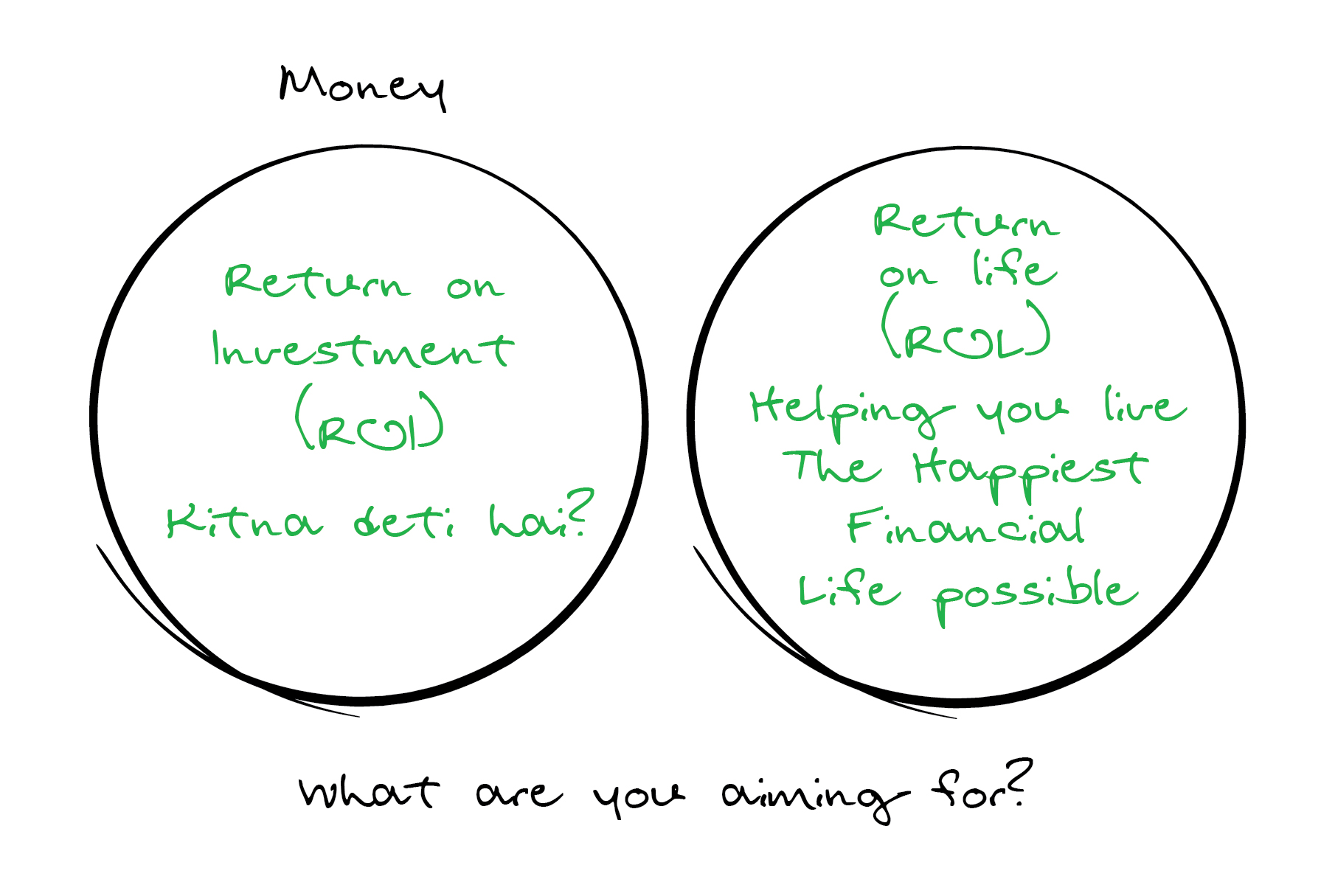
The purpose of investing is not simply to maximize wealth… It is to maximize what wealth can do for your life.
If the only objective is maximizing wealth, there is never a logical stopping point. Rs. 10 Crore should become Rs. 20 Crore. Rs. 20 Crore should become Rs. 50 Crore. Rs. 50 Crore should become Rs.100 Crore.
Why stop?
More is mathematically better. However, if the objective is living well, then the questions become richer.
How much is enough for security? What experiences matter while we are healthy enough to enjoy them? What do we want to do for our children without preventing them from building their own lives? How much do we want to give? What work would we continue doing even if we no longer needed the money? Whom do we want to spend more time with? What have we been postponing? What would we regret not doing?
One of the most important questions of all is: What is the point at which another crore creates less value than another year of freedom?
These are financial questions too and some of the most important ones.
There is another reason the Easterlin Paradox matters.
If relative income influences how wealthy we feel, then comparison is not merely an emotional problem. It becomes a financial risk.
Think about what comparison can make us do. Your portfolio returns 11 per cent. Your friend tells you he made 22 per cent. Suddenly 11 feels disappointing.
Nothing about your financial plan has changed. Nothing about your goals has changed. Nothing about the adequacy of your wealth has changed.
Only one piece of information entered your life… Someone else made more.
That additional information can cause you to take risks you did not need to take. You increase equity exposure. You chase the fund that just performed brilliantly. You buy the fashionable asset. You abandon diversification. You take leverage. You invest in something you barely understand because people around you appear to be getting richer faster.
The desire to become richer can be rational. The desire to become richer than somebody else has no natural finish line.
This is why “enough” is such a powerful financial concept.
Enough does not mean lack of ambition. It does not mean mediocrity. It does not mean stop creating, building, investing or growing.
Enough means knowing what game you are playing. It means having a point of reference that comes from your life rather than somebody else’s balance sheet. It means being able to look at another person’s success without interpreting it as evidence of your failure.
That is financial maturity and even emotional maturity.
Imagine two people.
One has Rs. 25 Crore and believes he needs Rs. 100 Crore before he can relax. Another has Rs. 20 Crore, understands exactly what his family needs, enjoys his work, has time for people he loves, takes care of his health, travels, gives generously and sleeps peacefully.
Who is richer?
The spreadsheet has an easy answer… Life may have a different one. This is why I increasingly believe that financial life planning must eventually graduate from accumulation to allocation in the broadest possible sense.
It is not merely about asset allocation… It is about Life allocation.
How much money? How much time? How much attention? How much energy? How much ambition? How much is reserved for today and how much for tomorrow? How much for yourself, how much for your family and how much for people you may never meet?
We spend extraordinary amounts of intelligence optimizing portfolios… we should spend equal intelligence optimizing lives.
There comes a point when the greatest return available from your money may not come from another 1 per cent of portfolio performance.
It may come from using the money… using it thoughtfully…using it intentionally…using it while time, health and relationships still allow it to create something meaningful.
This could mean an experience. Freedom. Education. Generosity. Time with family. Starting something. Stopping something. Helping somebody or simply buying yourself the space to live at a different pace.
None of this means spending recklessly. In fact, it is quite the opposite.
Financial security matters precisely because insecurity creates enormous stress. The objective is not to swing from mindless accumulation to mindless consumption. The objective is intentionality.
Saving without purpose becomes hoarding. Spending without purpose becomes consumption. Investing without purpose becomes scorekeeping.
Purpose changes all three.
You save because something matters. You invest because the future matters. You spend because the present matters. You give because other people matter.
This is a much more complete philosophy of money (and is the subject of the book I am working on).
It also explains why the question “How much is enough?” cannot be answered with one universal number.
Enough is not Rs. 5 Crore, Rs. 10 Crore or Rs. 100 Crore. Enough depends on the life being funded.
A family spending Rs. 20 Lakh annually has a different number from one spending Rs. 2 Crore. Someone who loves working may need a different level of financial independence from someone desperate to leave his career. Someone who wants to leave enormous intergenerational wealth has a different objective from someone who wants to give most of it away.
Enough is personal but the absence of an answer is dangerous. This is because if you never define enough, the default answer becomes more.
The tragedy is that more is a destination that keeps moving as you approach it.
This is the deepest insight in the Easterlin Paradox.
The paradox is not that money does not matter. It certainly matters a lot. The paradox is that after money has solved the problems money is particularly good at solving, we continue asking it to solve problems for which it was never designed.
We ask money to give us meaning, status, love, belonging, identity, self-worth and peace. We ask the portfolio to tell us whether we are winning at life.
This is too much responsibility to place on a financial asset.
A portfolio can fund your life… It cannot define your life.
The job of a thoughtful financial professional is not merely to help clients accumulate more. It is to help them understand when more is useful, when more is unnecessary and what the money is ultimately there to accomplish.
Sometimes the correct financial advice may indeed be to save more… sometimes it may be to invest more… sometimes it may be to take less risk… sometimes it may be to stop chasing returns.
Occasionally, the most valuable financial advice could be: You have enough.
Take the trip. Help your children. Give some away. Work because you want to, not because you are frightened to stop. Spend more time with your parents while they are still here. Take care of your health. Do the thing you have been postponing for ten years.
Your financial roadmap can afford it, but your life may not be able to afford waiting forever.
This is a very different definition of financial advice.
It is closer to what money was always supposed to be about because the ultimate objective was never to die with the highest possible XIRR.
Nobody reaches the end of life and asks his family to bring him the latest portfolio statement so he can admire the compounding one final time.
The numbers matter because of what they make possible. The freedom. The security. The experiences. The people we can help. The worries we can remove. The choices we can create.
The life we can live.
Money is extraordinarily powerful when we understand its role. It becomes dangerous when we ask it to become the scoreboard for everything else.
Richard Easterlin’s paradox therefore contains a lesson that goes far beyond economics.
The first part of the wealth journey is about having more. You need to earn, save, invest, compound, and create financial independence.
Do all of it.
At some point, the question must change. This is not because money has stopped mattering…it is because something else has started mattering more.
The question changes from: “How can I make more?” to: “What is all this more for?”
This may be one of the most important questions an investor can ever ask.
There is a tragedy worse than not having enough money. It is having enough and never realizing it.
Continuing to run after the next number… continuing to postpone the life… continuing to compare… continuing to accumulate the tool while forgetting what you wanted to build with it.
One day the portfolio may finally reach the number you once dreamed about… it might even exceed it. You may be richer than you ever imagined becoming.
The Easterlin Paradox though still whispers something worth remembering. There is a point at which the next unit of wealth may add far more to your net worth than it adds to your life.
When that happens, do not stop respecting money. Do not stop investing. Do not stop compounding.
Ask your money to do a different job.
Ask it to buy freedom. Ask it to create memories. Ask it to reduce worry. Ask it to give you time. Ask it to help people you love. Ask it to support something bigger than yourself. Ask it to turn wealth into well-being.
The highest purpose of money is not to keep becoming more money forever. The highest purpose of money is eventually to help you live the life you truly want to live.



 and then tap on

0 Comments