Who Knew This?

Amar Pandit , CFA , CFP 

November 24, 2026 | 12 Minute Read
Who knew a few weeks ago that Jensen Huang would suddenly find himself at the center of revelations about multiple extramarital relationships?
Who knew that one of those relationships would involve a woman suspected by American authorities of having links to Chinese intelligence?
Who knew that the founder and CEO of one of the most valuable companies on earth would suddenly resign?
Who knew that Nvidia would lose more than a trillion dollars of market capitalization?
Then, just when everybody was beginning to construct a perfectly sensible narrative explaining why the company had entered a completely different era, who knew that Jensen Huang would make a stunning comeback?
Who knew that Nvidia would reinstate him?
Additionally, who knew that the stock would then rise more than 31 per cent in a single trading session, adding almost a trillion dollars of market value back in one day?
Think about that for a moment.
This is not one year or even one quarter. It’s one day.
Now forget Jensen Huang and Nvidia for a moment because this post is not about either of them.
Let’s go home.
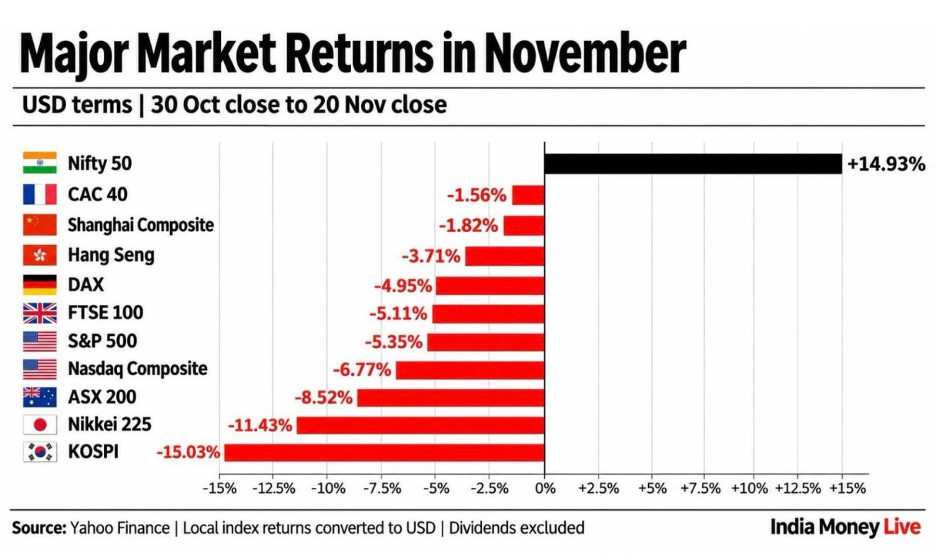
Look at the picture above.
At the end of October, who knew this was going to happen in November?
Who knew that while major markets across the world were falling, India would suddenly stand out so dramatically?
Who knew that the Nifty 50 would behave this way?
Who knew that foreign investors, after months of concern around India, would suddenly pour enormous amounts of money back into Indian equities?
Who knew that the narrative around India could change this quickly?
Don’t think too much. The correct answer is wonderfully simple, “No one.”
This is one of the most important truths in investing – “We don’t know.” Yes, that does not stop us from pretending that we do and that is the fascinating part. I know of countless experts who said we are not going to get foreign money soon or we are doomed.
The investment industry is filled with intelligent people explaining what is going to happen next. Every January, there are outlook reports. Every quarter, there are forecasts. Every week, there are television experts. Every day, somebody tells us what the market will do because of interest rates, inflation, earnings, oil, geopolitics, currencies, liquidity, elections, tariffs, artificial intelligence or the Federal Reserve.
The explanations are often sophisticated… The charts are impressive… The vocabulary is excellent… The confidence is extraordinary.
Something then happens that nobody had on the chart. This is how markets work. The biggest events are often not merely things we forecast incorrectly. They are things we never thought of forecasting at all.
Imagine asking an investor at the end of October to write down everything that could affect Nvidia over the next month. He might have written AI spending. Semiconductor demand. China. Export controls. Competition. Valuation. Earnings. Margins. Data-center capital expenditure. Interest rates. Perhaps even geopolitics.
How many investors would have written: The CEO’s personal relationships will trigger a governance crisis, he will leave the company, enormous market value will disappear, a campaign will emerge to bring him back, he will return and the stock will rise more than 30 per cent in one day?
Nobody is the right answer again. It wasn’t a low-probability forecast; it wasn’t even in the forecast.
We spend so much time debating the probability of events we can imagine that we forget about the enormous universe of events we cannot imagine. The stock markets live in that universe too. This is why I have always found extreme confidence about the future so strange.
It is not that intelligent people cannot analyze. Surely, they can. It is not that economics does not matter; it does. It is not that valuations, earnings, interest rates and business fundamentals are irrelevant. They are enormously important.
The problem begins when analysis quietly becomes prophecy. There is a point at which “Here is what I think might happen” becomes “Here is what will happen.” This small linguistic shift can create enormous financial consequences. It’sbecause once we believe we know what will happen, we begin building portfolios that require us to be right. This is exactly where the trouble begins.
Suppose at the end of October you had looked around the world and concluded that India was unattractive. Maybe you had perfectly respectable reasons such as valuations looked expensive or that foreign investors had been selling or that you preferred America as AI looked like the greatest opportunity or that Korea and Taiwan were looking cheaper.
You certainly could have built an intelligent argument… created a beautiful presentation… come up with twenty charts supporting your conclusion.
November then arrived. This is one of the market’s favorite tricks. It does not always prove your analysis foolish. Sometimes it simply reminds you that your analysis was incomplete.
It’s a much more important lesson because all analysis is incomplete. The future contains information that does not exist yet. It contains decisions that have not been made. It contains inventions that have not been invented. It contains wars that have not begun. It contains agreements that have not been signed. It contains political decisions that have not been taken. It contains corporate scandals that have not been discovered. It contains human behavior that has not yet occurred. It contains accidents, surprises, luck, stupidity, brilliance, innovation, and things none of us would have even though about.
Despite this, we regularly build investment opinions as though the future were simply a spreadsheet waiting for the correct assumptions.
It isn’t. The future is alive. This is precisely why diversification exists. As I have written earlier, diversification is sometimes described as though it were an admission of ignorance.
In a sense, it is and this is exactly what makes it intelligent. You diversify not because you know what will happen. You diversify because you know that you don’t know.
If I knew with certainty which country would deliver the highest return over the next decade, why would I diversify geographically?
I would put everything there. Wouldn’t you put everything there?
If you knew which asset class would perform best, why would you own anything else? If you knew which mutual fund would be number one, why would you own another one? If I knew exactly when markets would fall and when they would recover, why would you tolerate volatility?
You and I would simply sell before every decline and buy before every rise.
This is amazing… isn’t it but there is only one small problem.
Nobody knows… not you… not me… not the smartest fund manager in the world… not the economist with twelve degrees… not the strategist appearing on television… not the person with the most sophisticated Bloomberg terminal… not the person with the largest following on social media.
Nobody.
Some people will get individual forecasts right. They will. With millions of predictions being made, somebody must be right.
The dangerous part is what happens next. We confuse a correct prediction with the ability to predict. If one thousand people flip a coin ten times, somebody may produce an astonishing sequence of heads. We would be foolish to appoint that person Chief Coin Strategist. The stock markets are far more complicated than coins, but human beings make a similar mistake.
Someone predicts a crash. The crash happens. Suddenly he becomes the man who predicted the crash. The next prediction receives enormous attention.
What we need to ask is not merely whether he got one prediction right. What were all his previous predictions? What did he predict that did not happen? How often was he early? How often was he late? How much money would an investor have made following every one of his forecasts?
The investment world has a peculiar memory. It remembers spectacular correct predictions and quietly forgets the incorrect ones. We create prophets retrospectively. However, there is an even deeper problem with forecasting.
Being right about the event does not necessarily mean being right about the market.
You might correctly predict a recession and still get the stock market wrong. You might correctly predict a war and still get the market wrong. You might correctly predict an election result and still get the market wrong. You might correctly predict interest-rate cuts and still get the market wrong. You might correctly predict excellent earnings and still get the stock wrong.
This is because stock markets do not react simply to events. They react to events relative to expectations and expectations are already embedded in prices.
This makes investing extraordinarily humbling.
You must predict the event. Then you must predict what everybody else expects the event to be. Then you must understand how much of that expectation is already reflected in the price. Then you must predict how people will react when reality differs from those expectations. Finally, you must predict what they believe everybody else will do.
Good luck doing this.
Something can happen that sounds terrible and the market rises. The headline says disaster. The market says, “Not as bad as expected.” Prices rise.
Something wonderful happens. The headline says fantastic. The market says, “We expected even better.” Prices fall.
The inexperienced investor looks at the screen and says, “This makes no sense.” It actually makes perfect sense. The market is not reacting to the news you just read. It is reacting to the difference between the news and the future that was already priced in.
This is also why hindsight is so dangerous. After something happens, explanations appear instantly. Markets rose because foreign investors returned. Markets fell because yields increased. Technology stocks rallied because AI spending remained strong. Indian equities outperformed because global investors rotated towards India.
The explanations may even be correct but notice what hindsight does. It makes the past look far more predictable than the future was.
Once something has happened, the chain of events begins to look obvious. Of course, this happened because that happened.
We create a clean story from a messy reality. We then quietly make the biggest mistake. We assume that because we can explain yesterday, we could have predicted it the day before.
We could not. Explanation is not prediction. I can explain beautifully why a particular stock crashed after it has happened. This does not mean I could have told you this before the crash that this stock would crash. The stock markets are filled with explanations masquerading as evidence of foresight.
November 2026 will eventually look obvious too. There will be charts. There will be essays. There will be economic explanations. There will be fund managers explaining why capital rotated. There will be strategists describing the relative attractiveness of India. In fact, Morgan Stanley came out with a new report explaining exactly this. There will be neat stories about what happened.
However, let’s go back to October 30 before the chart existed… before the money moved… before the events happened.
Who knew?
No one.
This does not mean we should give up thinking. It means we should think differently. The objective of intelligent investing is not to build a portfolio that works only if your prediction of the future is correct. The objective is to build a portfolio capable of surviving many futures, including futures you never predicted.
As we all know, there is a huge difference between forecasting and preparing.
Forecasting says, “I know what is coming.” Preparation says, “I don’t know exactly what is coming, so let us build something robust enough to deal with many possibilities.”
This is why a sensible financial life has diversification… why it has liquidity…|why it avoids unnecessary leverage… why it has an appropriate asset allocation… why it does not place the family’s financial future on one stock, one country, one theme, one fund manager, one prediction or one charismatic story… why it plans before the crisis rather than during it.
The goal is not to eliminate uncertainty. You cannot. We cannot. The goal is to make uncertainty survivable. This is how we live the rest of our lives too.
When you leave your home in the morning, you do not know whether you will have an accident, but you wear a seat belt. You don’t wear it because you have forecast an accident at 11:17 a.m. You wear it because you accept the possibility of something you cannot predict.
You buy insurance for the same reason. You don’t know whether your house will burn down. You don’t know whether you will be hospitalized. You don’t know exactly when you will die.
Insurance is not a forecast. It is preparation for uncertainty.
Planning is similar. It is financial humility turned into portfolio construction. The best part is humility is one of the most underrated sources of investment wisdom. People often think humility means lacking conviction. It does not.
You can have strong views and still understand that you may be wrong. You can believe equities will create wealth over long periods without knowing what they will do next month. You can believe India has an extraordinary long-term future without knowing whether India will outperform America next year. You can believe a business is excellent without knowing where its stock price will be six months from now. You can have a philosophy without pretending to possess a crystal ball.
This is not weakness… It is maturity.
In fact, some of the most dangerous words in investing are not “I don’t know.”
They are…
Continued in Part 2



 and then tap on

0 Comments