This is Where Better Investing Begins

Amar Pandit , CFA , CFP 

May 12, 2026 | 7 Minute Read
“Ashish, can I ask you something?”, Anil asked.
Ashish nodded.
“Of course.”
“Where do you think the world’s wealth is created?”
Ashish smiled.
“Everywhere, I guess. India, US, China… all major economies.”
Anil gave a thumbs up.
“Fair answer. Now let me show you something.”
He turned his screen towards Ashish.
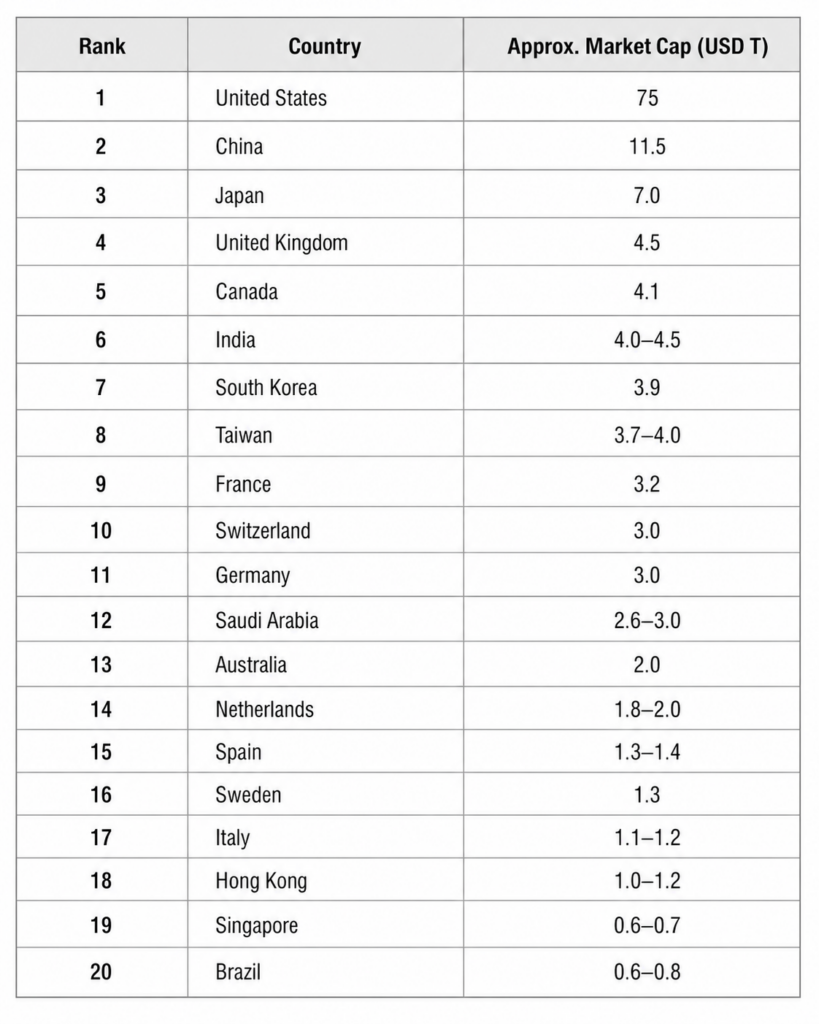
A simple table (that is shared above).
Top global markets.
United States at the top.
Around 75 trillion dollars.
More than half of the world’s total market capitalization.
Ashish seemed a bit shocked.
“More than 50 percent?” he asked.
“Yes,” Anil said calmly.
“And the total global market is about 150 trillion dollars.”
Ashish sat back.
“That’s… huge.”
Silence.
Because sometimes numbers don’t just inform.
They shift perspective.
“Let me ask you another question,” Anil said.
“What percentage of your portfolio is invested in the US?”
Ashish thought for a moment.
“None directly.”
“And indirectly?”
“Maybe some through Indian funds… but not much.”
Anil asked, “What about other countries?”
“Ok, you are participating in less than 96 percent of the world’s equity opportunity.”
Ashish smiled slightly.
“When you put it like that…”
Anil didn’t interrupt.
He let the thought settle.
“You know,” Ashish said, “I have always believed in India.”
“As you should,” Anil replied.
“India is a fantastic long-term story.”
“Demographics, growth, consumption, reforms.”
“All of it is real.”
Ashish nodded.
“Exactly.”
“But let me ask you something,” Anil continued.
“Does believing in India mean ignoring the rest of the world?”
Ashish paused.
“I never thought about it that way.”
Anil said, “You see, investing is not about choosing between India and the world.”
“It is about participating in the world.”
Ashish was now listening very carefully.
“Because companies are no longer local.”
“They are global.”
“The iPhone you use.”
“The software your company runs on.”
“The platforms your children spend time on.”
“These are not Indian.”
“They are global.”
“And most of them are listed in one market.”
Ashish smiled.
“The US.”
“Exactly.”
Anil said, “But it’s not just about the US. There are amazing companies in other parts of the world too.”
“Let me simplify this.”
“When you invest only in India, you are making two bets.”
“What bets?” Ashish asked.
“One, that India will do well.”
“And two, that India will do better than the rest of the world.”
Ashish nodded slowly.
“That’s true.”
“And while the first may be very likely,” Anil said,
“The second is uncertain.”
Silence again.
Because this is where most investors don’t go.
They think in terms of belief.
Not in terms of probability.
“Ashish,” Anil continued,
“Do you know what makes the US market so dominant?”
Ashish shook his head.
“Innovation.”
“Scale.”
“Capital.”
“Leadership in technology.”
“Global companies.”
He paused.
“The largest companies in the world are not just US companies.”
“They are global businesses listed in the US.”
“Apple.”
“Microsoft.”
“Google.”
“Amazon.”
“These companies earn from the world.”
Not just from the US.
Ashish was now hooked on.
“If I invest in the US…”
“You are not just investing in the US economy,” Anil said.
“You are investing in global innovation.”
“Global consumption.”
“Global leadership.”
“But what about risk?” Ashish asked.
“Currency risk. Market risk. Regulation.”
Anil smiled.
“Valid concerns.”
“But let me ask you something.”
“Is concentration not a risk?”
Ashish paused.
“Yes.”
“If all your investments are linked to one economy…”
“One currency…”
“One market…”
“Is that not risk?”
Ashish nodded slowly.
“It is.”
“Diversification is not just across investments,” Anil said.
“It is across geographies.”
“Across economies.”
“Across currencies.”
He paused.
“And global diversification is not about chasing returns.”
“It is about reducing dependence.”
Ashish sat quietly.
Then he said something interesting.
“You know, I always thought global investing was optional.”
Anil smiled.
“That is the biggest misconception.”
“It is not optional.”
“It is essential.”
“Let me connect this to something you once said,” Anil continued.
“You told me you want to think like an owner.”
Ashish nodded.
“Yes.”
“Then ask yourself this.”
“If you were building a business portfolio…”
“Would you invest only in one country?”
Ashish smiled.
“Probably not.”
“Exactly.”
“Because ownership demands diversification.”
“Ownership demands perspective.”
“Ownership demands participation beyond boundaries.”
Ashish said, “This is making a lot of sense.”
Anil continued.
“You had read that piece on Consumer vs Owner.”
Ashish nodded.
“Yes, I remember.”
“You said something interesting then.”
“What?” Ashish asked.
“You said you consume global products but invest locally.”
Ashish smiled.
“I remember that.”
Anil nodded.
“That is the gap.”
“You live globally.”
“But invest locally.”
There was a a silence for almost a minute because this one hit differently.
“Ashish,” Anil said,“global investing is not about abandoning India.”
“It is about complementing India.”
“It is about building a portfolio that reflects the real world you live in.”
Ashish looked at the table again.
The numbers.
The scale.
The imbalance.
“Where do we start?” he asked.
Anil smiled.
“We start by acknowledging reality.”
“The world is bigger than one market.”
“The opportunity is larger than one country.”
“And your portfolio should reflect that.”
He paused.
“And then we build thoughtfully.”
“Gradually.”
“Intentionally.”
“Aligned to your goals.”
Ashish nodded.
“This is not about chasing the US.”
“No,” Anil said.
“This is about not ignoring it.”
They both smiled.
Because sometimes.
The biggest change is not in what you add but in what you stop ignoring.
As Ashish walked out, the table stayed on the screen.
United States.
75 trillion dollars.
More than half the world.
And for the first time.
It did not feel like a statistic.
It felt like a blind spot.
And maybe.
Just maybe.
That is where better investing begins.



 and then tap on
0 Comments