The Storm Above and the Business Beneath

Amar Pandit , CFA , CFP 

October 6, 2026 | 15 Minute Read
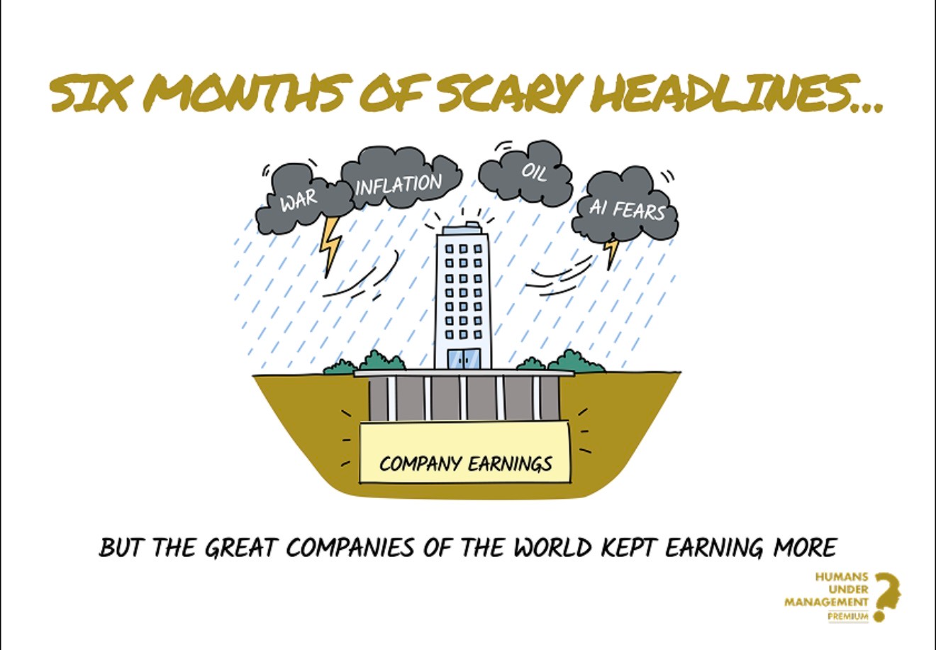
Look at the visual above for a moment. At the top are the things that dominate our attention.
War… Inflation… Oil… AI fears… Dark clouds. Lightning. Rain. Uncertainty everywhere.
Underneath all of that sits something remarkably boring.
Company earnings.
This is one of the most important pictures an investor can understand.
It’s because investing constantly asks us to decide where to direct our attention. Towards what is happening above the ground, where the headlines live, or towards what is happening beneath the ground, where businesses quietly create value.
The problem is that the first is infinitely more interesting. Nobody wakes up in the morning to a breaking-news alert saying:
“Millions of companies around the world opened for business again today.”
There is no television debate announcing that factories produced goods, software companies wrote code, banks made loans, pharmaceutical companies researched new drugs, retailers sold products, engineers solved problems and entrepreneurs tried to make their businesses a little better than they were yesterday.
That isn’t news.
It happens every day.
On the other hand, let a war begin somewhere…let oil jump 15 per cent…let inflation surprise economists…let somebody announce that artificial intelligence will destroy millions of jobs.
Suddenly everything is urgent.
Markets react…Experts appear…Predictions multiply.
Then investors begin wondering whether the entire financial life plan they built for the next twenty years needs to be changed before lunch.
This is one of the strangest features of investing.
The things that matter most over decades often receive the least attention each day, while the things receiving the most attention each day often matter far less over decades.
That does not mean wars don’t matter. They do.
Inflation matters… Oil matters… Interest rates matter… Politics matters… Technology matters… Geopolitics matters.
All of these can affect economies, businesses, valuations and markets, sometimes profoundly.
However, something else matters too.
Human beings keep going to work. Companies keep adapting, entrepreneurs keep solving problems and capital keeps searching for productive uses. Technology improves productivity, businesses find new markets, costs are managed, new products are created and millions of people continue trying to make their organizations a little better than they were yesterday. None of this makes for particularly exciting news. But over long periods, these seemingly ordinary activities become extraordinarily powerful. The storm gets the headline. The compounding happens underneath it.
Imagine that twenty or thirty years ago someone had handed you a newspaper containing, in advance, every frightening headline you would encounter over the decades ahead. Wars, terrorist attacks, recessions, financial crises, bank failures, political shocks, a global pandemic, inflation, interest-rate shocks, oil spikes, technology bubbles, currency crises and countless predictions that the world economy was heading towards disaster. Imagine knowing all of this before investing a single rupee. Would you have invested? I suspect many sensible people would have said no. Presented all at once, the future would have looked terrifying.
Yet, while all those frightening events were happening, something else was happening quietly underneath them. Businesses continued operating. Some failed and disappeared, while others that once looked invincible became irrelevant. Entire industries were disrupted. New businesses emerged, existing companies adapted, new technologies created new industries, productivity improved and entrepreneurs created enormous amounts of value. The world certainly did not move forward in a straight line, but it moved forward.
Investors sometimes forget this progress. We confuse a difficult world with a world in which businesses cannot prosper. Businesses have always operated inside uncertainty. There was never some golden period when entrepreneurs knew exactly what inflation would be, where interest rates were headed, what politicians would do or when the next crisis would arrive. Uncertainty is not an interruption to capitalism. It is the environment in which capitalism has always operated. The remarkable thing is not that storms keep appearing. It is that human beings and great businesses keep finding ways to adapt to them.
We look backwards at history, and it appears strangely orderly because we already know how the story ended. The crises eventually passed, economies recovered, businesses adapted and markets moved forward. But living through history feels nothing like reading about it afterwards. At every point, the ending is unknown. There is no narrator reassuring us that everything will eventually be fine. The future is always uncertain when you are standing inside it, and that uncertainty is precisely what makes investing so emotionally difficult.
Consider what happens during a frightening period. The investor sees the storm, but the CEO sees the same storm. The difference is that the CEO cannot simply switch off the television and wait for better times. He has customers to serve, employees to pay, competitors to fight, suppliers to manage and shareholders to answer to. If input costs rise, the business looks for efficiencies or changes prices. If consumer preferences shift, it changes products. If technology threatens the existing business, it invests in technology. If one market weakens, it searches for another. If supply chains break, it rebuilds them. If competitors become stronger, it innovates. Investors experience uncertainty, but businesses must respond to it.
Of course, not every company succeeds. Capitalism can be brutally unforgiving. Bad businesses disappear, poorly managed companies lose relevance, and entire industries can be transformed beyond recognition. That relentless process of destruction, adaptation and reinvention however is also one reason owning a diversified collection of productive businesses has historically been such a powerful way to participate in human progress. You are not merely buying pieces of paper whose prices move up and down on a screen. You are becoming a part-owner of businesses filled with people who wake up every morning trying to solve problems, serve customers and create something people are willing to pay for.
This is why the phrase “stock market” sometimes does investors a disservice. The word “market” immediately makes us think about prices. Nifty up. Sensex down. Nasdaq falling. S&P rising. Green screen. Red screen. Behind every ticker symbol is a business. Behind that business are customers. Behind those customers are needs. Behind those needs are human beings willing to pay somebody who can serve them better. When we buy equities, we are not ultimately investing in stock prices. We are investing in businesses. The price is simply what somebody is willing to pay us for our share of that business today.
This distinction becomes especially important when frightening headlines dominate our attention. A share price can move dramatically in a single day because expectations, emotions or perceptions about the future have changed. The underlying business rarely changes at the same speed. A company does not suddenly lose 15 per cent of its factories because its share price fell 15 per cent. Its employees do not become 15 per cent less intelligent. Its patents do not disappear, its distribution network does not evaporate, and its customers do not automatically vanish. Sometimes, of course, a falling share price is correctly anticipating a genuine deterioration in the business. But many a times, it is simply reflecting fear, uncertainty or a different price, investors are currently willing to pay. Price is visible every second. Value reveals itself much more slowly.
Human beings naturally pay attention to what moves. That is why the visual is so powerful. Everything above the surface is dramatic. The clouds gather, lightning flashes, rain falls and the storm screams for our attention. Meanwhile, underneath all that noise sit company earnings, almost unnoticed. They are quieter, slower and far less exciting. Businesses continue selling, adapting, reinvesting and trying to earn more. The storm entertains our attention. The earnings quietly compound our wealth.
This is the nature of many important things in investing. Compounding is boring. Saving regularly is boring. Diversification is boring. Asset allocation is boring. Rebalancing is boring. Owning productive businesses patiently for decades can be incredibly boring. Watching financial television during a crisis is anything but boring. Neither is checking your portfolio twelve times a day, predicting what markets will do next, moving money because of an election or chasing whatever asset has just doubled. One feels like action. The other often feels like doing nothing. However, excitement and importance are not the same thing, and investing becomes dangerous when we confuse them.
There is also a structural reason headlines capture us so effectively. Headlines are designed around change, while wealth is often created through continuity. “Company continues executing its strategy” is unlikely to get much attention. “Investors panic as oil surges” certainly will. “Thousands of profitable businesses reinvested their earnings today” will never trend. “Markets wipe out Rs. 10 lakh crore of investor wealth” probably will. One is designed to make you look. The other is quietly helping businesses grow.
Therein lies one of the great paradoxes of long-term investing. What changes rapidly gets our attention, while what compounds slowly creates the wealth. The investor who understands that distinction begins looking beyond the storm. He still sees the clouds, but he no longer mistakes them for the entire sky.
There is an enormous mismatch between the speed at which we consume information and the speed at which wealth is created. We consume news hourly, receive market prices every second and demand immediate explanations for movements caused by thousands of variables. Businesses, meanwhile, create value over years and investment strategies unfold over decades. Yet we routinely allow information with a lifespan of a few hours to influence money that may have a time horizon of twenty or thirty years. You may be investing for retirement in 2045, but a frightening headline published at 10:37 this morning suddenly makes you question the entire plan. Something designed to capture your attention for thirty seconds begins influencing money designed to compound for twenty years. That is allowing the shortest time horizon in the room to control the longest one.
This becomes particularly dangerous when the headlines are frightening. Our instinct is to reduce uncertainty: move to cash, wait for things to settle and invest again when there is more clarity. It sounds perfectly sensible. The problem is that markets rarely ring a bell announcing that clarity has returned. By the time the world feels comfortable again, prices may already have moved significantly. Good prices and good news rarely arrive together. This does not mean blindly buying every decline or pretending valuations do not matter. It means accepting a fundamental truth about investing: the absence of uncertainty is not a prerequisite for investing. If it were, nobody would ever invest.
The future has never been certain. Only the subject of our uncertainty keeps changing. Yesterday it was inflation, today it may be war, tomorrow it may be artificial intelligence, and five years from now it will probably be something we are not even discussing today. The headline changes, but our emotional response is remarkably consistent. We take whatever is happening now and imagine it continuing indefinitely. High inflation feels permanently high, rising oil appears destined to keep rising, falling markets seem certain to fall further and booming markets make permanent prosperity feel perfectly reasonable. Human beings are remarkably good at turning temporary conditions into permanent stories. Businesses cannot afford that luxury. They must adapt.
Adaptation may be one of the most underappreciated forces in long-term investing. The great companies of twenty years from now will not operate exactly as they do today. They will use technologies that are only emerging now, sell products that may not yet exist and solve problems we have not yet encountered. Some of today’s leaders will disappear, while businesses we barely know today may become enormous. The process will be messy, but the beauty of owning a diversified collection of productive businesses is that you do not have to correctly predict every winner in advance. You don’t need to know which entrepreneur creates the next great company, which technology transforms the world, who governs in 2035 or what oil costs in 2040. You need to believe something much broader: human beings will continue trying to solve problems, create value and improve their lives.
That is ultimately what long-term ownership of productive assets represents. It is not a bet on perfection. It is a bet on progress. This progress has never meant the absence of problems. Wars happen, recessions happen, companies fail, markets crash, bad policies get implemented and technologies destroy industries that once looked permanent. None of this should ever be trivialized. Problems however are often the very things that provoke human ingenuity. High energy prices encourage efficiency and alternatives. Labor shortages encourage automation. Competition encourages innovation. Scarcity encourages invention. Technological disruption forces businesses to become better or makes room for somebody who will. Human beings are not passive observers of economic history. We respond.
That, to me, is one of the strongest foundations for long-term optimism. Optimism does not mean believing markets will rise tomorrow or pretending that wars, recessions and economic problems do not matter. It certainly does not mean ignoring valuations or risk. Intelligent optimism says something far more modest and, I believe, far more powerful: I do not know what the next problem will be, but I have enormous respect for humanity’s ability to eventually respond to problems. The pessimist may occasionally be right about the storm. The long-term optimist is betting on something different: our capacity to eventually build stronger roofs.
There is another distinction investors need to understand. The stock market and the economy are not the same thing. The economy and today’s headlines are not the same thing. Today’s headlines and your financial plan are certainly not the same thing. Yet during frightening periods, we collapse all three into one emotional conclusion: “Something bad is happening, therefore I should do something with my portfolio.” That “therefore” may be one of the most expensive words in investing. Something bad happening somewhere in the world does not automatically tell you what to do with a diversified portfolio designed for the next twenty years.
There must be another step between the headline and the decision. Has the long-term earning power of the businesses I own changed? Has something changed in my financial life? Has my time horizon changed? Has my need for this money changed? Has the reason I originally invested changed? These are far more useful questions. An investment plan should never remain unchanged regardless of reality, but neither should it be changed merely because reality temporarily feels frightening. Action should emerge from changed facts or changed circumstances, not merely changed emotions.
This is also where a thoughtful financial professional becomes invaluable, not because he knows what happens next, but because he knows that nobody does. His/her value is often the opposite of prediction. He helps you avoid behaving as though today’s headline has somehow given you knowledge about tomorrow that nobody possesses. During calm markets, investors often think they need forecasting. During difficult markets, they discover that what they really needed was perspective. Perspective reminds us that the portfolio was not designed for six months, that different assets have different jobs, that liquidity should have been provided for before the storm arrived and that volatility was always part of the bargain. Most importantly, it reminds us of something incredibly easy to forget: the news is happening to the world, but the portfolio exists to fund our life.
If you are 50 years old and investing for another thirty or forty years, there will not be one storm. There will be dozens. You will see recessions, wars, political upheavals, bubbles, crashes, technological disruptions and experts confidently announcing that the investment principles of the past no longer apply. If every storm causes you to dismantle your portfolio and rebuild it around the latest fear, the greatest risk to your financial life may not be the storm itself. It may be your reaction to it.
This is why successful long-term investing can feel strangely uneventful. The investor keeps saving, keeps investing, keeps rebalancing and keeps owning productive assets. Businesses continue earning and reinvesting while the world produces an endless supply of reasons why none of this should work. Then twenty years pass. The headlines that once seemed impossible to ignore become paragraphs in history books, many barely remembered. Meanwhile, the companies that survived and adapted spent those twenty years selling, building, inventing, hiring, reinvesting and compounding. The investor experienced twenty years of headlines. The businesses experienced twenty years of opportunities to create value.
That is what the visual captures so beautifully. Storms happen above the ground. Roots grow underneath it. We spend enormous amounts of time staring at the weather because storms are dramatic and roots are invisible. A great tree does not survive for decades because storms somehow avoid it. It survives because its roots are strong enough to withstand them. Your financial life should be constructed in much the same way, not around the fantasy that nothing frightening will happen, but around the expectation that many frightening things will. Diversification, liquidity, sensible asset allocation, avoiding excessive leverage, owning productive assets and having the emotional discipline to stick with a thoughtful plan are all part of building those roots. The goal is not to predict the weather perfectly. It is to build something capable of surviving different kinds of weather.
Six months of frightening headlines can feel like an eternity while you are living through them. A year can feel enormous. But over a thirty-year investment life, even an extraordinary year eventually becomes one chapter. Great businesses do not stop operating because that chapter is uncomfortable. They adapt, solve, compete, invest and earn. That is why one of the most useful habits an investor can develop during frightening periods is to occasionally look beneath the headline and remember what he owns. Not a ticker symbol. Not a chart. Not today’s market price. You own pieces of businesses containing people trying to build things, sell things, solve things and improve things. Not all of them will succeed, which is precisely why we diversify. Collectively, over long periods, human enterprise has proved extraordinarily difficult to stop.
Remember the picture now or check it out again. There will be wars, inflation, oil shocks, recessions, elections, technological fears and crises none of us can currently imagine. The headlines will keep changing. Yet underneath them, largely ignored by the news cycle, millions of people will wake up the next morning and go back to work. Companies will open their doors, customers will buy things, entrepreneurs will take risks, scientists will discover, engineers will build, businesses will adapt, earnings will be created and capital will be reinvested. Almost unnoticed, the quiet machinery of compounding will begin another day.
That is what long-term investing ultimately asks us to understand. The storm is real. But so are the roots. Wealth is not created by pretending that storms will never come. It is created by building a financial life capable of surviving them and owning productive assets whose roots can continue growing through them. The headlines will always tell us about the storm because that is what deserves today’s attention. But underneath the noise, almost invisibly and over decades, the roots are doing the work that ultimately creates tomorrow’s wealth.



 and then tap on
0 Comments