The Wrong Game

Amar Pandit , CFA , CFP 

April 21, 2026 | 7 Minute Read
“Sanjay, I don’t think I need much help.”
Arjun said it with quiet confidence.
Not arrogance.
But certainty.
He leaned forward.
“I understand investing quite well. I track markets. I read a lot. I compare funds. I know costs. In fact, that’s where most people go wrong. They overpay.”
Sanjay smiled.
“That’s good,” he said.
“Awareness is always a great starting point.”
Arjun continued.
“I have a simple framework. Keep costs low. Compare everything to the benchmark. If something is not beating the benchmark, why hold it?”
Sanjay nodded.
“Fair point,” he said.
“Let me ask you something. Why do you invest?”
Arjun didn’t take long.
“To grow my money.”
“And why do you want to grow your money?”
“For my future. For my family. For financial security.”
Sanjay leaned back.
“This means your goal is not really to beat a benchmark.”
Arjun paused.
“Well… no. But that’s how you measure performance, right?”
“Is it?” Sanjay asked gently.
There was a moment of silence.
“Sanjay, what else is there?” Arjun asked.
Sanjay smiled.
“Let’s explore that together.”
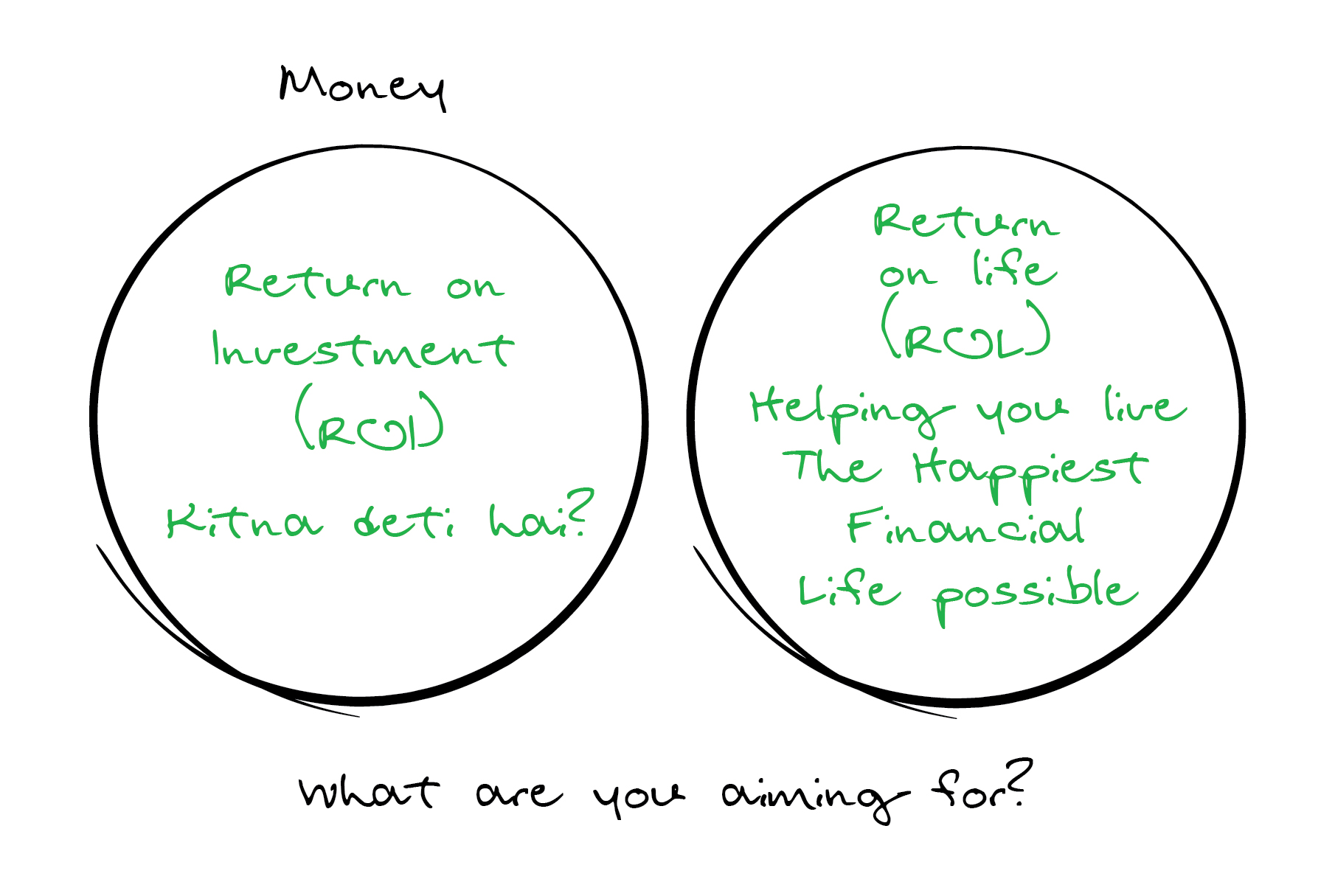
He picked up a pen and drew two simple lines on a sheet of paper.
“Let’s imagine two professionals,” he said.
“One is an asset manager. The other is a wealth professional.”
Arjun leaned forward.
“Both deal with money. Both make investment decisions. But their jobs are very different.”
He pointed to the first line.
“An asset manager’s job is to manage a pool of money. He is compared to a benchmark. His success is defined by whether he beats that benchmark over time.”
Arjun nodded.
“That’s what I’ve been saying.”
“Yes,” Sanjay said.
“And that is correct.”
He paused.
“But now let’s look at the second line.”
“The wealth professional.”
“What do you think his job is?”
Arjun thought for a moment.
“To help me invest?”
Sanjay smiled.
“That’s a small part of it.”
He continued.
“A wealth professional’s job is not to beat a benchmark.”
“It is to help you live your life by aligning the use of your money with what’s important to you.”
Arjun frowned slightly.
“That sounds a bit philosophical.”
“It is,” Sanjay said.
“But it is also very practical.”
He leaned forward.
“Tell me, Arjun. If your portfolio beats the benchmark but you cannot fund your child’s education when you need to, is that success?”
Arjun shook his head.
“No.”
“If your portfolio outperforms but you run out of money in retirement, is that success?”
“No.”
“If you make great returns but you are constantly anxious, checking markets every day, losing sleep, is that success?”
Arjun was quiet.
“No.”
Sanjay continued.
“Then what is success?”
Arjun thought for a moment.
“Achieving my goals. Being financially secure. Not worrying about money.”
Sanjay smiled.
“Exactly.”
“And that,” he said, “is the benchmark of a wealth professional.”
There was a shift in the room.
Small.
But real.
Sanjay continued.
“You see, Arjun, benchmarks are useful tools. But they are not your life.”
“They are not your child’s education.”
“They are not your retirement.”
“They are not your peace of mind.”
Arjun nodded slowly.
“But costs matter,” he said.
“I have always believed that lower cost is better.”
Sanjay smiled.
“Costs do matter. But only in context.”
“What do you mean?”
“Let me ask you this,” Sanjay said.
“If you choose the lowest cost option but it does not help you stay invested during difficult times, what is the real cost?”
Arjun thought.
“I may exit at the wrong time.”
“And what does that do?”
“It hurts my returns.”
“Exactly,” Sanjay said.
“The cheapest option is not always the most valuable.”
He paused.
“True cost is not just what you pay. It is what you lose because of wrong decisions.”
Arjun leaned back.
This was new.
Sanjay continued.
“A wealth professional helps you avoid those mistakes.”
“He helps you stay disciplined.”
“He helps you align your investments with your life.”
“He ensures that you have money when you need it.”
“Not just when the market is doing well.”
Arjun was listening carefully now.
“But how do you measure that?” he asked.
Sanjay smiled.
“That’s the interesting part.”
“You don’t measure it every day.”
“You experience it over time.”
He continued.
“You experience it when markets fall and you do not panic.”
“You experience it when your goals are funded without stress.”
“You experience it when you sleep well at night.”
“You experience it when you do not have to constantly think about money.”
Arjun nodded slowly.
“That sounds very different from what I have been doing.”
Sanjay smiled.
“It is.”
He paused.
“Let me tell you a simple truth.”
“Beating a benchmark is a relative game.”
“Living a fulfilled financial life is an absolute one.”
Arjun looked at him.
“Relative vs absolute?”
“Yes,” Sanjay said.
“In a relative game, you are always comparing.”
“Am I better than this index?”
“Am I ahead of others?”
“In an absolute game, you are asking a different question.”
“Am I on track for my life?”
“Am I prepared for my future?”
“Am I at peace?”
There was silence.
Deep.
Reflective.
“Sanjay,” Arjun said finally, “I think I have been playing the wrong game.”
Sanjay smiled.
“Not wrong. Just incomplete.”
Arjun laughed softly.
“Fair enough.”
He leaned forward again.
“What should I do now?”
Sanjay picked up the paper again.
“We start by redefining your benchmark.”
“No longer the Nifty or any index.”
“But your life.”
He continued.
“We map your goals.”
“We understand your timelines.”
“We assess your risks.”
“We build a plan that is designed to work across market conditions.”
“And then we follow it.”
Arjun nodded.
“And investments?”
“They become tools.”
“Not the end.”
“Just like a surgeon uses tools for surgery.”
“The outcome matters more than the tool.”
Arjun smiled.
“I like that.”
Sanjay continued.
“And over time, something interesting happens.”
“What?”
“You stop chasing returns.”
“And you start achieving outcomes.”
Arjun leaned back.
There was a calmness now.
A different kind of confidence.
Not based on knowing more.
But on understanding better.
“Sanjay,” he said, “one last question.”
“Of course.”
“Will I still care about costs and benchmarks?”
Sanjay smiled.
“Yes.”
“But they will no longer control you.”
“They will inform you.”
“Not define you.”
Arjun nodded.
“That makes sense.”
As he stood up to leave, he paused.
“You know,” he said, “I walked in thinking I knew a lot.”
Sanjay smiled.
“And now?”
“I realize I was focusing on the wrong things.”
Sanjay nodded.
“That realization,” he said, “is where real investing begins.”
Arjun smiled.
“And where real peace of mind comes from.”
Sanjay nodded.
“Exactly.”
Because in the end.
Investing is not about beating a benchmark.
It is about building a life.
Where money quietly does its job.
So that you can live yours which is the real measure of success.



 and then tap on
0 Comments