When Feelings Meet Markets

Amar Pandit , CFA , CFP 

March 10, 2026 | 6 Minute Read
There might be some questions on your mind today.
How long will this war last?
What will happen to the global economy?
What will happen to oil prices?
What will happen to the stock market?
If I am being completely truthful, the answer to all of these questions is the same.
No one knows.
War creates uncertainty. And uncertainty makes prediction impossible.
If history has taught us anything, it is that conflicts often last far longer than anyone expects.
The Russia–Ukraine war began in 2022.
Four years later, it continues.
The Israel–Gaza conflict continues as well.
This latest escalation could also stretch far longer than headlines suggest today. Wars rarely follow neat timelines that economists or commentators draw on television.
And like many of you, I feel deeply for the innocent lives lost in these conflicts. Behind every headline are families, children, and communities caught in circumstances they never chose.
It is important to acknowledge that human dimension.
But when it comes to the stock markets, where we actually have real experience and evidence to guide us, the story is very different from what our emotions often tell us.
History shows that geopolitical conflicts usually have limited long-term impact on the trajectory of markets.
This does not mean markets ignore wars. They don’t.
Markets react quickly. They become volatile. They move sharply in the short term as investors try to process new information and new risks.
But over time, markets tend to focus on something else entirely.
Economic activity.
Corporate earnings.
Innovation.
Productivity.
Human progress.
These forces are far more powerful and far more persistent than any single geopolitical event.
The world does not stop.
Businesses continue to operate.
People continue to work.
Ideas continue to evolve.
Entrepreneurs continue to build.
Even during the darkest periods of history, the machinery of human progress rarely stops turning.
Still, it is completely natural to feel uneasy during moments like these.
We are human beings first and investors second.
When the news cycle becomes intense, when headlines speak of war, sanctions, oil shocks, and geopolitical tensions, it is only natural for emotions to rise.
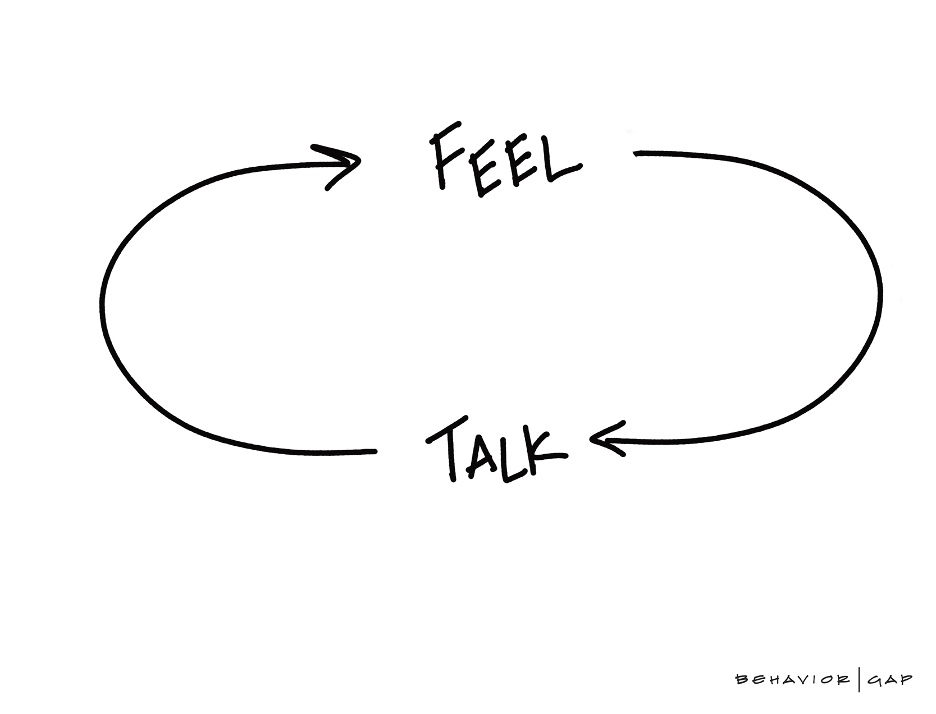
And that brings us to the simple sketch above.
Feel → Talk → Feel → Talk.
We read the news.
We feel anxious.
We discuss it with friends, family, or colleagues.
That conversation amplifies the feeling.
We then read more news.
Which fuels more conversation.
And the cycle continues.
In investing, this loop can sometimes become dangerous because it pushes us toward decisions that are driven by emotion rather than thoughtful planning.
That is precisely why portfolios must be designed before crises occur, not during them.
The strategy we have put in place for you was built with exactly these moments in mind.
We know markets can fall sharply.
We know volatility can arrive suddenly.
We know uncertainty can dominate headlines.
That is why your portfolios are structured so that money required in the next few years is kept in liquid and stable assets. This buffer exists specifically to give you peace of mind during turbulent periods.
It allows us to avoid forced decisions when markets are unsettled.
It allows us to remain patient.
It allows us to look beyond today’s headlines.
At the same time, when markets decline due to fear and uncertainty, we often use those moments to deploy capital thoughtfully and gradually.
Not recklessly.
Not emotionally.
But carefully.
This approach is intentional.
It allows us to build positions when valuations become more attractive while maintaining the stability required for your near-term needs.
The entire framework was designed so that, even in moments like this, you can sleep well at night.
Because ultimately, investing is not about predicting the next headline.
It is about building a structure that can survive many headlines.
The world will always have crises.
Wars.
Pandemics.
Political shocks.
Economic cycles.
Yet through all of this, the long arc of economic progress has remained remarkably resilient.
This does not mean we dismiss the seriousness of current events.
It simply means we recognize that markets and economies are complex systems capable of absorbing shocks over time.
Our optimism about the future of the world is not a denial of today’s pain or uncertainty.
It is a recognition of humanity’s extraordinary ability to adapt, rebuild, and move forward.
Still, we also understand that numbers and charts cannot fully address emotions.
Markets are mathematical.
But investors are human.
If you are feeling uneasy, if headlines are creating anxiety, or if you simply want to talk through what is happening, please reach out.
Sometimes the most helpful thing is not a chart or a statistic.
Sometimes it is simply a conversation.
If you feel something, call us.
Or better still, let us meet for coffee.
Because while markets may fluctuate, relationships and trust are what truly sustain long-term investing journeys.
And in times of uncertainty, those conversations matter more than ever.



 and then tap on
0 Comments