The Real Problem To Solve

Amar Pandit , CFA , CFP 

March 24, 2026 | 7 Minute Read
Most people make decisions about money without first answering a much more important question.
What do I actually want from life?
This may sound like a philosophical question, but it is in fact the most practical financial question you will ever ask.
Because when you do not know what you want, the world will happily decide for you.
The industry will decide for you.
Benchmarks will decide for you.
Product manufacturers will decide for you.
And before you realize it, you are chasing numbers that may have very little to do with the life you actually want to live.
Look at how most investors think about money.
They ask questions like:
What is the return on this product?
Did my portfolio beat the benchmark?
Is this fund outperforming the index?
Is my portfolio doing better than the market?
These questions are not wrong.
Returns matter.
Performance matters.
But something strange happens when these questions become the only questions we ask.
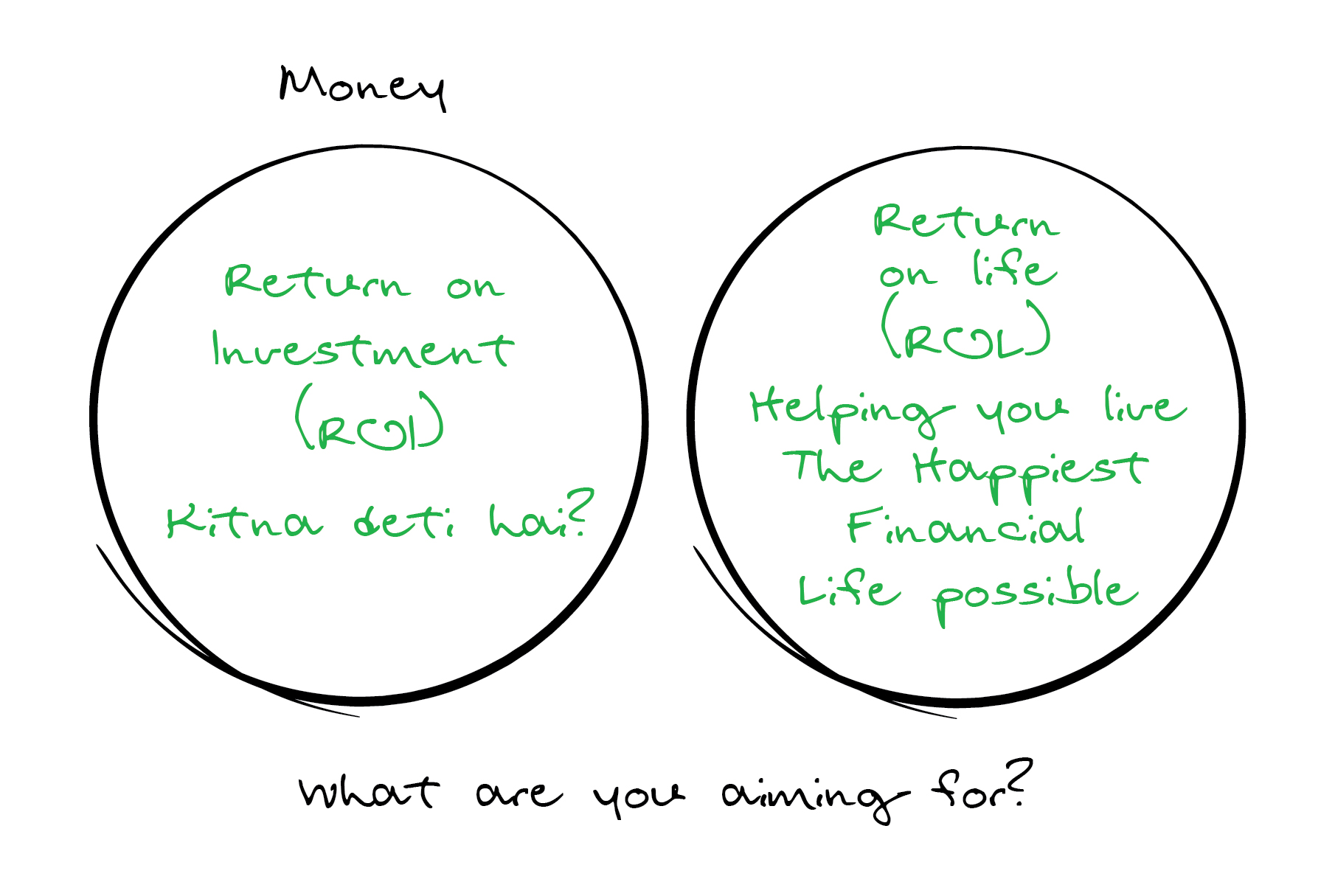
Money quietly stops being a tool.
And starts becoming the master.
When that happens, investors start running a race whose finish line they never defined.
They begin measuring success using numbers that someone else chose.
A benchmark that someone else created.
A metric that someone else decided was important.
Think about this for a moment.
Why exactly do you have to beat some random benchmark?
Why does your life need to outperform the Nifty or the S&P 500?
What will actually change in your life if your portfolio earns 11% instead of 10%?
Will you spend more time with your family?
Will you suddenly become healthier?
Will your relationships become deeper?
Will your life become more meaningful?
For most people, the honest answer is no.
This does not mean returns do not matter.
They absolutely do.
But they are not the ultimate objective.
They are simply one of the inputs.
Money, at its core, is a tool.
A powerful tool.
But still a tool.
Just like a hammer.
Just like a knife.
Just like a computer.
A hammer can build a home.
Or it can sit unused in a toolbox.
The tool itself is neutral.
What matters is the purpose behind it.
The same is true for money.
Money can buy freedom.
Money can reduce stress.
Money can create opportunities for the people you love.
Money can allow you to say no to things that do not align with your values.
Money can help you contribute to causes that matter to you.
Money can allow you to live with dignity and independence.
But money can also create endless anxiety if you never define what it is meant to do.
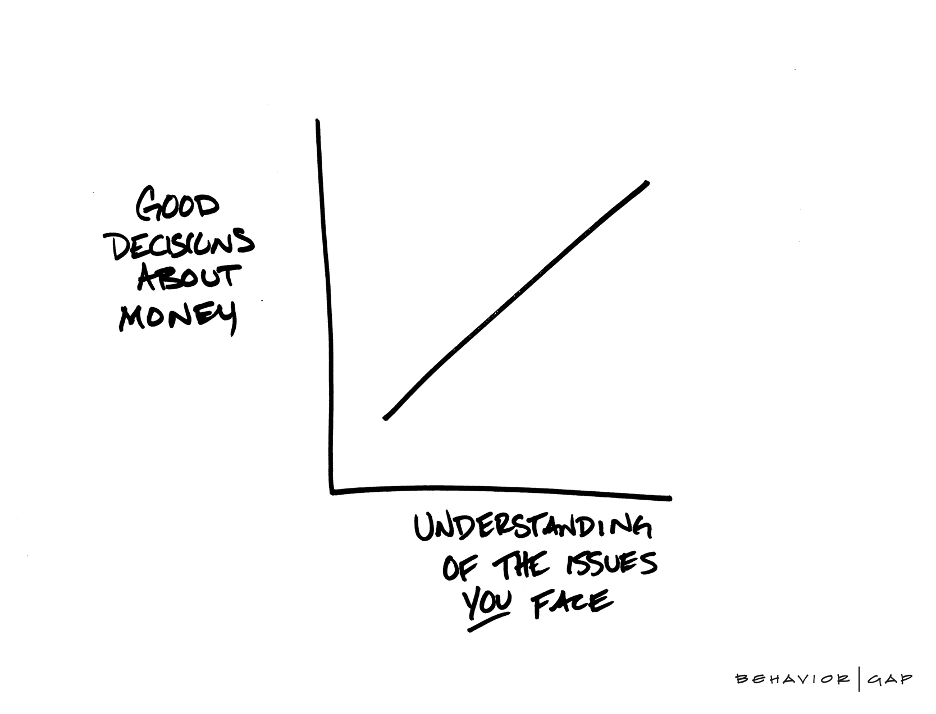
This is where the sketch above becomes important.
Good decisions about money improve as your understanding of the issues you face improves.
That sounds simple.
However in reality, it changes everything.
Because the quality of your financial decisions is not determined by how many financial products you know about.
It is determined by how clearly you understand your life.
Your priorities.
Your responsibilities.
Your fears.
Your dreams.
Your timeline.
Your values.
Imagine two investors.
Both have the same amount of money.
Both have access to the same markets.
Both have access to the same financial products.
But their lives are very different.
One investor is trying to build financial independence so he can spend more time with his children.
Another investor wants to secure the education of his daughter.
Another investor wants stability and peace of mind in retirement.
Another investor wants to support charitable causes.
If these four investors chase the same benchmark, they may all be making the wrong decision.
Because their lives are different.
Their goals are different.
Their definition of success is different.
And therefore their use of money should also be different.
This is why blindly chasing benchmarks often creates confusion.
Benchmarks measure market performance.
But they do not measure life satisfaction.
They do not measure peace of mind.
They do not measure alignment between your money and your values.
And yet investors spend an extraordinary amount of time worrying about whether they beat an index.
This creates a strange paradox.
You can beat the market and still feel financially insecure.
You can outperform benchmarks and still feel anxious about money.
Because the benchmark was never the real problem to solve.
The real problem was clarity.
Clarity about what money is meant to do in your life.
Once that clarity emerges, financial decisions become surprisingly simpler.
You stop chasing every new opportunity.
You stop worrying about every market fluctuation.
You stop comparing your portfolio to everyone else.
Instead, you begin asking a different set of questions.
Is my money helping me live the life I value?
Is my financial strategy aligned with what matters most to me?
Does my portfolio give me freedom or does it give me stress?
Does my capital support my priorities?
Or is it quietly pushing me into a race I never intended to run?
These are deeper questions.
But they lead to far better decisions.
Because when money is clearly defined as a tool, you regain control.
You become the one using the tool.
The tool no longer uses you.
You recognize that money is incredibly important.
But it is important because of what it enables.
Not because of what it measures.
When investors reach this understanding, something interesting happens.
Their relationship with money changes.
They still care about growth.
They still care about discipline.
They still care about returns.
But they stop obsessing over every number.
Because they know the real objective is not to win a benchmark competition.
The real objective is to build a life that feels meaningful, secure, and aligned with who they truly are.
And that kind of wealth cannot be measured by an index.
It can only be measured by how well your money supports the life you want to live.



 and then tap on
0 Comments