The Inner Scorecard

Amar Pandit , CFA , CFP 

December 12, 2025 | 3 Minute Read
In investing and in life, there is one distinction that separates people who build lasting wealth from those who simply perform for the crowd.
Warren Buffett calls it the Inner Scorecard.
In Alice Schroeder’s Buffett biography, ‘The Snowball”, there is an anecdote about Warren Buffett near the end of 1999. Buffett says, “The big question about how people behave is whether they have got an Inner Scorecard or an Outer Scorecard. It helps if you can be satisfied with an Inner scorecard. I always pose it this way. I say: ‘Would you rather be the world’s greatest lover, but have everyone think you are the worst lover? Or would you rather be the world’s worst lover but have everyone think you are the greatest?’ Now that’s an interesting question.
‘Here’s another one. If the world couldn’t see your results, would you be rather thought of as the world’s greatest investor but in reality have the world’s worst record? Or would be thought of as the world’s worst investor when you were actually the best?’
“In teaching your kids, I think the lesson they are learning at a very, very early age is what their parents put the emphasis on. If all the emphasis is on what the world’s going to think about you, forgetting about how you really behave, you will wind up with an Outer Scorecard. Now my dad: he was a hundred percent Inner Score-card guy.”
This is not just a philosophical musing. It cuts straight to the heart of how people behave with their money.
Most investors today live with an Outer Scorecard.
They worry about what others are earning.
They compare returns in WhatsApp groups.
They judge success based on noise, not on clarity.
They feel proud when markets rise, ashamed when they fall, and often act only to protect their image.
The Outer Scorecard is the enemy of long-term wealth.
Because once you start playing to the crowd, you stop playing the right game. You start chasing performance, trends, predictions, and opinions. You forget the only score that matters.
Your own.
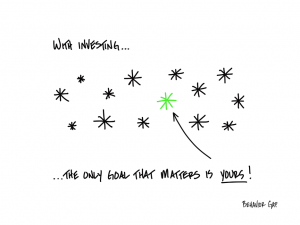
The Inner Scorecard is quieter.
It asks very different questions.
Are you investing according to your goals or according to someone else’s excitement?
Are you taking risks because they suit your plan or because they make you look smart?
Are you building wealth steadily or performing wealth publicly?
The Inner Scorecard demands honesty. It requires patience. It forces you to define success without borrowing the world’s definition.
It also frees you.
When you invest with an Inner Scorecard, you no longer panic because someone else made more in a mid-cap fund last year. You no longer abandon your plan because a neighbor doubled their money in something speculative. You no longer jump from idea to idea simply because someone might think you are missing out.
You move from comparison to conviction.
From insecurity to clarity.
From noise to wisdom.
The investors who win over decades are not the loudest.
They are the ones who quietly keep score within.
Because compounding does not respond to applause.
It responds to discipline.
The Inner Scorecard is not only Buffett’s philosophy.
It is the foundation of every investor who has ever created real, lasting, meaningful wealth.
Which scorecard do you follow?
Choose the right scorecard.
Your future self will thank you.



 and then tap on
0 Comments