The Investment Everyone Wants – Expanded Version

Amar Pandit , CFA , CFP 

October 20, 2026 | 17 Minute Read
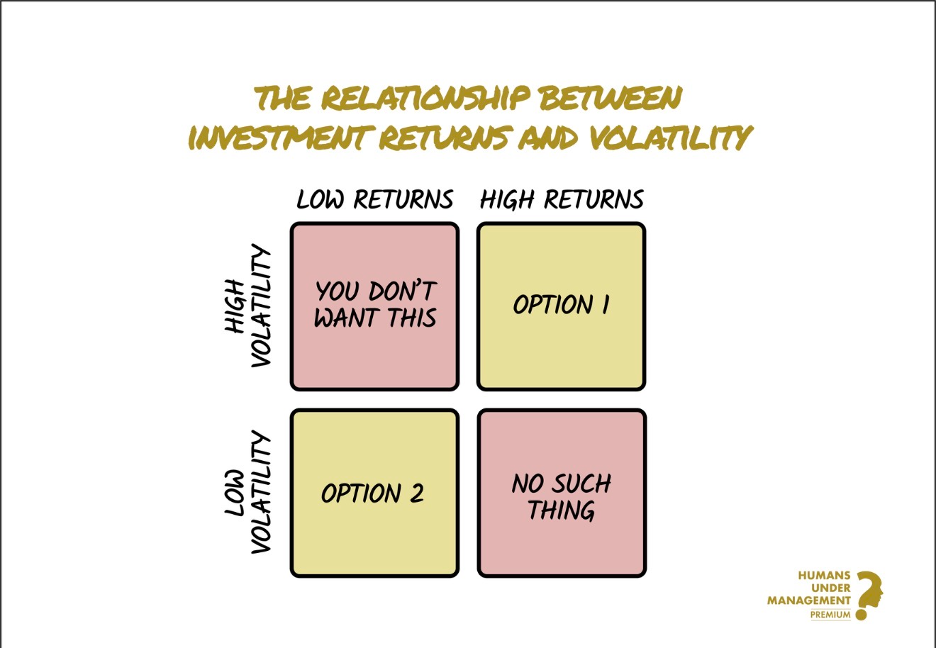
I wrote a Nano about this visual a couple of weeks back. Many of you loved it and some of you requested that I elaborate on it.
This is a wonderfully simple visual about investing that every investor should look at least once every year.
It has only four boxes.
On one side are returns: low returns and high returns.
On the other side is volatility: low volatility and high volatility.
The first box offers low returns with high volatility.
Nobody wants that.
The second offers high returns with high volatility.
That is Option 1.
The third offers low returns with low volatility.
That is Option 2.
Then comes the fourth box.
High returns with low volatility.
The box every investor wants. The box almost every investment presentation somehow seems to promise. Inside that box are three wonderfully inconvenient words:
NO SUCH THING.
I love this visual because it captures one of the oldest desires in investing.
We want the reward without the discomfort required to earn it. We want equity-like returns with fixed-deposit-like stability. We want our money to compound aggressively, but we do not want to watch it fall. We want to participate fully when markets rise yet somehow be protected whenever they decline. Give us double-digit returns, a smooth journey, predictable outcomes, complete liquidity and preferably no unpleasant surprises along the way. In other words, we want investing to behave in a way investing has never behaved.
There is an entire financial industry that will periodically try to convince us that perhaps, this time, it can. A new product appears, a clever structure is created, or a sophisticated strategy is presented that seems to offer the wonderful combination we have always wanted: more return with less discomfort. This is where investors need to become particularly thoughtful, because one of the fundamental truths of investing is remarkably simple: return and discomfort are usually travelling companions.
This relationship is not mechanical. Taking more risk certainly does not guarantee a higher return. There are plenty of terrible investments that involve enormous risk and eventually produce dreadful outcomes. The reverse idea though is extremely important. If somebody promises meaningfully higher returns while simultaneously suggesting that you will experience almost no uncertainty, volatility or possibility of disappointment, don’t immediately become excited. Become curious. Very curious.
Markets generally do not hand out superior returns simply because investors would like them. There is usually a price somewhere. Sometimes that price is volatility. Sometimes it is illiquidity, credit risk or concentration. Sometimes it is complexity. Sometimes it is uncertainty about when you can get your money back. Occasionally the risk is hidden so beautifully inside a complicated structure that you do not even realize what you are paying until something goes wrong. Risk does not disappear merely because you cannot see it on your statement.
This is an incredibly important point because investors naturally associate movement with risk. An investment whose price changes every second looks risky because every fluctuation is visible. Another investment whose value is updated once a quarter can appear wonderfully stable. The frequency with which something is priced tells us surprisingly little about what could ultimately happen to our money. Sometimes volatility is visible risk. Sometimes apparent stability is simply hidden risk.
Imagine two roads taking you towards the same destination. One has bends, slopes and bumps, and you feel every movement along the way. The second appears perfectly smooth. Which road is safer? You cannot possibly answer that question simply by looking at how smooth the surface appears. You need to know what lies underneath it. Yet investors often judge investments in exactly this way. If the number on the screen moves, we call it risky. If the number does not move, we instinctively feel safer (like in real estate). However, a smooth-looking journey tells you nothing about whether the bridge ahead is strong.
Equities, in this sense, are brutally honest. Every trading day, they tell you what somebody is willing to pay for your ownership in a business. Prices move, sometimes violently. A perfectly good company can fall 20 per cent. An entire market can fall 30 or 40 per cent. During extraordinary periods, declines can be even greater. Watching that happen feels terrible. The visibility of that volatility though does not automatically make equities inappropriate for a long-term investor. In many cases, volatility may simply be part of the admission price for participating in the long-term growth of productive businesses.
This is where investors often confuse two very different things: volatility and permanent loss are not the same thing. A portfolio temporarily falling in value is painful. Capital being permanently destroyed is something else entirely. If a diversified equity portfolio falls 25 per cent during a broad market panic and subsequently recovers over time, the investor experienced significant volatility. If an investor puts most of his wealth into one speculative business that eventually collapses, he has experienced permanent destruction of capital. For a while, the charts might even look similar. The eventual financial outcomes could not be more different.
There is another reason volatility is so difficult to live with. Human beings do not experience volatility as an abstract mathematical concept. We experience it as money. A 30 per cent decline on Rs. 10 Lakh means Rs. 3 Lakh. A 30 per cent decline on Rs. 10 Crore means Rs. 3 Crore. Mathematically, they are identical. Emotionally, they can feel like completely different events. Suddenly, volatility is no longer a percentage in a presentation. It looks like years of savings disappearing from a screen. It begins to look like your children’s education, your retirement, your home, your freedom and your security.
This is when an investor asks a perfectly understandable question: “Why do I have to go through this?” The uncomfortable answer is that the return you want may require you to tolerate something you don’t. That is the bargain. We happily discuss the return side of that bargain when markets are calm but rarely spend enough time thinking about the emotional price attached to earning it.
Most investment conversations therefore begin with the wrong question: “What return can I make?” It is an understandable question, but it is incomplete. There is another question that deserves equal attention: “What will I have to live through to earn it?” That question takes us away from the seductive destination and forces us to think about the journey required to reach it.
Suppose somebody tells you that an investment has the potential to deliver 14 per cent over long periods. Almost everybody immediately notices the 14. Far fewer ask what the path towards that 14 might look like. Could the investment fall 20 per cent? Could it fall 40 per cent? Could it underperform for three years? Could another asset class dramatically outperform it while you wait? Could the investment thesis take five years to work? Most importantly, could you watch Rs. 5 Crore become Rs. 3.5 Crore without abandoning the very investment whose long-term return attracted you in the first place?
These are not pessimistic questions. They are essential questions because the return printed at the end of a long period tells you almost nothing about what the investor had to endure in the middle. Investing in its purest form is lived in the middle. Nobody experiences a twenty-year investment journey by teleporting from the starting value to the ending value.We live through every correction, every crisis, every disappointing year and every moment when somebody else appears to be doing much better than us.
Historical charts hide this beautifully. We look backwards and see a neat line connecting two points. Rs. 1 Crore became Rs. 5 Crore. Wonderful. The chart though does not communicate the emotional reality of all the nights between those two numbers. It does not capture the crashes, recessions, wars, elections, interest-rate shocks and frightening headlines. It does not show the years when nothing seemed to work, the periods when another investment performed spectacularly better or the moments when selling appeared not only tempting but completely rational.
History compresses decades of uncertainty into a chart we can understand in thirty seconds. The investor had to live every single day of it. This is one of the reasons long-term returns are so easy to admire retrospectively and so extraordinarily difficult to earn prospectively. Looking backwards, we see the destination. Living forwards, the investor experiences the journey.
This is where we need to rethink the meaning of volatility itself. We have been conditioned to treat volatility as inherently bad. Lower volatility appears better; higher volatility appears worse. However, volatility alone tells us surprisingly little about whether an investment is appropriate. A volatile investment owned for the right reason, in the right allocation and with enough time may be perfectly sensible. A seemingly stable investment containing risks we do not understand may be far more dangerous.
The real question is not whether an investment will make you uncomfortable. Almost every worthwhile long-term investment will eventually do that. The question is whether the discomfort you are being asked to endure is understood, appropriate and worth the potential reward.
Successful investing was never about finding an investment that gives us everything we want without asking anything from us in return.
It is about understanding the price of the return we seek and then deciding whether we have the temperament to pay it.
Think about how naturally we accept this idea everywhere else in life. Physical fitness requires discomfort. Building a successful business requires uncertainty. A meaningful career inevitably contains difficult periods. Raising children can bring unimaginable joy, but nobody would describe the journey as uninterrupted tranquility. We instinctively understand that many worthwhile outcomes require us to endure something along the way. When it comes to investing though, we suddenly want the laws of life suspended. We want compounding without waiting, growth without uncertainty and returns without volatility. That is not investing. That is wishing.
Whenever human beings desperately want something that reality cannot reliably provide, somebody eventually arrives promising to provide it. That is why the most seductive part of the visual is the box containing the combination every investor wants: high returns and low volatility. Of course, the real world is far more nuanced than four boxes. Diversification matters, portfolio construction matters and unnecessary risks can certainly be reduced. None of this however changes a fundamental truth. There is no magical asset that permanently offers extraordinary returns, negligible risk, perfect liquidity and complete predictability. If such an investment genuinely existed, capital would rush towards it until the extraordinary return disappeared. Markets are not usually generous enough to leave free money lying around indefinitely.
Every few years, the same promise returns wearing different clothes. Sometimes it is a product, sometimes a fund, sometimes a fashionable asset class and sometimes an extraordinarily complicated structure whose payoff requires several pages to explain. The language changes, the packaging becomes more sophisticated and the story feels new. The human desire underneath it however remains the same: Give me more without making me endure more. This desire, rather than any particular investment, is where some of our biggest financial mistakes begin.
This is also why complexity can be so seductive. If you own equities, you understand what the discomfort looks like. Markets can fall sharply and everybody can see it happening. Now show an investor a sophisticated structure offering an attractive return with “downside protection,” and suddenly it appears that somebody has discovered a way around the trade-off. The risk has genuinely been reduced, or it has merely moved somewhere less visible. Maybe your upside is capped. Maybe you have accepted credit risk or sacrificed liquidity. Maybe the protection works only within certain conditions. Maybe the apparent smoothness is being purchased through a risk that does not reveal itself every day. Never confuse a risk you don’t understand with the absence of risk.
There is another important lesson hidden inside the visual. Low return and low volatility are not somehow an inferior combination. Sometimes it is exactly what you need. Money required next year for your daughter’s education should not necessarily be asked to maximize returns. Money for a house purchase three years from now has a different job from money intended for retirement twenty years away. Emergency money has a different purpose from generational wealth. This is why asking, “Which investment gives the highest return?” is almost meaningless without context. The far more useful question is: “What job does this money need to do?”
Once you understand the job, the trade-off between return, risk, liquidity and time becomes much clearer. The trouble begins when we ask low-volatility assets to deliver high-growth outcomes and high-growth assets to behave like low-volatility ones. An equity portfolio is not defective because it occasionally falls. A conservative debt allocation is not defective because it fails to participate fully in an equity bull market. Cash is not useless because it earns less than equities. Each exists for a reason. A portfolio is not a competition between its parts.
Yet powerful market cycles make us forget this. When equities soar, debt suddenly looks foolish. When gold soars, we wonder why we do not own more gold. When small caps explode, large caps look boring. When international markets outperform, domestic investments suddenly seem inadequate. The objective of diversification was never to ensure that everything in your portfolio performs brilliantly at exactly the same time. In fact, if every part behaved identically, there would be very little point in diversifying in the first place. A well-diversified portfolio almost guarantees that at any given moment you will be disappointed with something you own. That disappointment is evidence that diversification is doing its job.
The purpose of a portfolio is not to maximize bragging rights at the next dinner party. It is to finance a life. Financing a life requires much more than returns. It requires liquidity when you need money, stability where uncertainty would be dangerous, growth where you have enough time to tolerate it, diversification because the future is unknowable and enough emotional resilience to remain invested when one part of the portfolio inevitably disappoints you. The different pieces are not competing against each other. They are working together to perform different jobs.
This is where the investor himself enters the equation, because the best portfolio is not necessarily the one with the highest expected return. It is the one you can live with. There is little value in constructing a theoretically brilliant portfolio capable of producing wonderful long-term returns if its volatility causes you to abandon it during the first serious decline. An investment return that exists beautifully on a spreadsheet but cannot be captured by the human being who owns the portfolio is not really that investor’s return.
Two investors can therefore own the same portfolio and end up with completely different outcomes. Both experience a 30 per cent fall. One understands what is happening, remains invested and eventually participates in the recovery. The other cannot tolerate the uncertainty, sells and waits for things to become clearer. The investments were identical. The market experience was identical. The behavior was different, and therefore the return was different. Portfolio construction is as much about human behavior as it is about mathematics.
This is why a thoughtful financial professional should never merely ask an investor how much return he wants. Almost everybody wants more. Ask somebody whether he would prefer 8 per cent or 14 per cent and you are unlikely to have a particularly illuminating conversation. The real conversation begins on the other side of the equation. What uncertainty can you tolerate? How much temporary decline can you live through without panicking? When will the money be needed? What would make you abandon the plan? How did you behave during previous market declines? Most importantly: How much volatility can your emotional life absorb?
Your spreadsheet may say you can afford risk. Your stomach may disagree. Neither should be ignored. A good portfolio must respect both because investing does not happen only inside Excel sheets. It happens inside human beings. We have a fascinating tendency to want high returns when markets are rising and low volatility when markets are falling. In a bull market, we want the growth. In a bear market, we suddenly want the stability. Looking backwards, we would like to have owned equities immediately before every rally and cash immediately before every crash. If we could reliably do that, we would indeed have discovered the magical investment everyone wants. Unfortunately, it requires something investors have been unsuccessfully searching for forever: perfect foresight.
The better answer is not to eliminate uncertainty. It is to build a financial life capable of living with it. Different money should have different jobs. Maintain enough liquidity so a market decline does not force you to sell growth assets at the worst possible moment. Diversify because you cannot know precisely what will outperform next. Rebalance so yesterday’s winner does not quietly become tomorrow’s entire portfolio. Above all, align the risk you take with the discomfort you can realistically survive. The greatest investment plan in the world is useless if you cannot stay with it.
That is what the wonderfully simple four-box visual is really teaching us. On the surface, it appears to be about the relationship between returns and volatility. But underneath, I think it is about something much more human: the relationship between desire and reality. We desire high returns, stability, certainty, liquidity and protection. There is nothing wrong with wanting any of these things. The mistake is believing we are entitled to all of them simultaneously. Investing begins to mature when we stop searching for an impossible combination and begin making intelligent trade-offs.
Some money needs safety, so let it be safe. Some money needs growth, so allow it the uncertainty required for growth. Some money needs liquidity, so do not burden it with the responsibility of maximizing returns. Money that has decades to compound should not necessarily be denied the opportunity for growth simply because the journey occasionally becomes uncomfortable. The art is not finding one magical investment that does everything. The art is building a financial life in which different investments do different jobs.
There is no perfect investment. There are only investments with different trade-offs. There is no growth without uncertainty, no long-term equity premium without periods when owning equities feels deeply uncomfortable and no financial plan capable of removing every unpleasant emotion from investing. That was never the objective. The goal is not to eliminate discomfort. The goal is to make sure the discomfort you experience is one you understand, one you can afford and one you can live through without destroying the plan.
Once an investor truly understands this, he stops searching for magic. He stops asking why his growth assets occasionally fall and stops becoming frustrated when his conservative assets fail to soar. He no longer expects every component of the portfolio to win simultaneously because he understands why each one exists. Most importantly, he understands that volatility is not always evidence that something has gone wrong. Sometimes volatility is simply evidence that you chose an investment capable of giving you something more.
There will always be another product promising a smoother ride, another strategy offering better returns with less risk and another presentation showing an attractive number while spending remarkably little time explaining what could go wrong. Whenever that happens, remember the impossible box: high returns, low volatility, perfect liquidity and very little discomfort. It is the investment everyone wants, the investment every generation searches for and the investment somebody will always claim to have discovered. The wisest investors eventually stop searching. They accept something far more useful than perfection. They accept the trade-off.
Once you accept that every return has a price, the question changes completely. You stop asking, “How can I earn high returns without experiencing volatility?” and begin asking, “What kind of volatility am I willing and able to live through in pursuit of the returns my financial life actually needs?” This is a much more mature question because it connects the investment not merely to a return target, but to the life the money is ultimately supposed to fund.
This is the deepest lesson hidden inside the visual. The best portfolio is not the one that promises you the highest return with the least volatility. It is the one that gives you enough return to achieve what matters, enough stability to survive what comes and enough peace of mind to remain invested when markets inevitably become uncomfortable.
Ultimately, the best portfolio is not the one that looks perfect on paper… It is the one you can live with in the real world.



 and then tap on

0 Comments